Passing on ·
Questions to ask your parents: what makes the difference
The right questions to ask your parents aren't always the ones you'd expect. Here's how to open the conversation, and thirty directions across major themes.
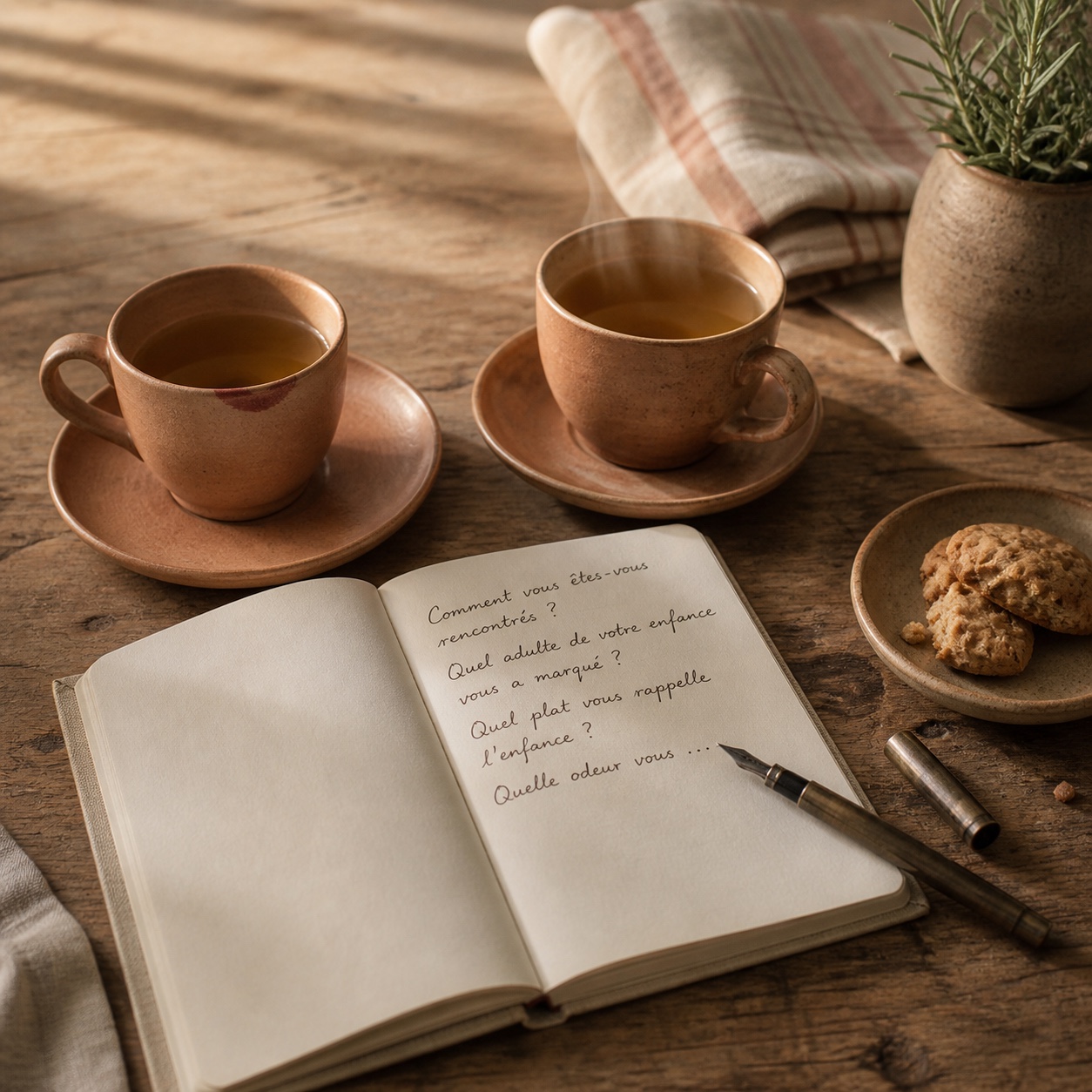
You may have thought of it already. Your parents are getting older, your grandparents too, and you’ve told yourself that one day you should sit down and ask. Ask about their childhood, their twenties, how they met, what they remember of their work, what they hope for you. And then you didn’t. Because you don’t know how to open it, because you’re afraid of being clumsy, because you keep putting it off.
This article gathers questions to ask your parents, by major themes, and offers a few markers so the conversation goes well.
Why ask at all
Parents don’t tell themselves spontaneously to their adult children. They did it when those children were small: the war, the moves, the disappeared grandparents. But once we’re adults, something closes: they don’t want to weigh us down, don’t want to look like they’re rambling. They wait to be asked.
Asking is giving them permission. It’s saying: what you lived through interests me, take the time to tell it. Many let themselves be carried with visible relief.
It’s also a way to keep what no one else can ever tell. Once the conversation is over, it stays. If you write it down or record it, it stays for your children, your nieces and nephews, your grandchildren. What you note today will be read in thirty years.
Before you begin: three markers
One question at a time. Don’t hand over a list. Slip a question into the conversation, listen to the answer all the way through, let what’s coming come. If, ten minutes later, the wish is still there, ask another.
No staging. No camera set up, no interview posture. The more the setting is familiar (the kitchen, the living room, the car), the more speech flows.
Silence isn’t a problem. If the person goes quiet, don’t fill the gap. Silence lets what’s searching rise. Many precious memories come out in the second minute after a question, not the first.
Thirty questions to ask, by major themes
Childhood and origins
- What’s the furthest your memory reaches back?
- What was the house of your childhood like? A room you see at once?
- Who did what in the house? Who cooked, who fixed things, who decided?
- Which adult of your childhood marked you the most, and why?
- What game, what object, what sound takes you back to age five?
Parents and grandparents
- What did your parents pass on to you without putting it in words?
- Is there something you regret not having asked them?
- How did your grandparents meet? Do you know?
- Which trait of your mother, your father, do you see in yourself today?
- Which family argument left a long trace?
Love and family
- How did you meet the person you built your life with?
- What first sign told you it was them?
- Which decision taken together turned out to be the most important?
- When we were small, what surprised you about being a parent?
- Is there something you only learned by becoming a grandparent?
Work and vocations
- How did you choose your craft? Did you have another dream before?
- What’s the episode you’re proudest of in your working life?
- Which mistake took you the longest to digest?
- Is there a craft you learned that no one else will know how to do?
- If you had to pass on one thing to a young person starting out, what would it be?
Places and journeys
- What’s the place you’re most attached to, and why?
- Is there a house you left that still misses you?
- Which journey truly changed you?
- Which town would you like to see once again?
Convictions and wishes
- Which conviction have you held all your life?
- What are you proudest of, looking back?
- Is there something you long believed and no longer do?
- What truly matters, for you, today?
- What would you like your grandchildren to keep of you?
- If there were one sentence to pass on to those who follow, which one?
How to record the answers
Three methods work, depending on your family.
Out loud, recorded. Ask permission, lay the phone flat on the table, forget it. You’ll transcribe later if you wish. Many people find recording easier than writing, because the voice carries things text flattens (laughter, hesitations, the words being searched for).
Out loud, noted afterwards. If recording feels awkward, take two or three notes during the conversation, and write down that same evening what you remember. You’ll lose precision; you’ll gain liveliness.
In writing, at a distance. For some parents, writing works better than speaking. You can send them a question a week, by message or letter, and let them take the time to answer. A service like Carnely allows you to set this frame without any particular kit.
When the questions become a book
After a few months, sometimes more, sometimes less, you’ll have a set of answers. Make something of it. A digital file shared between siblings. A printed book for the seventieth birthday. A folder you’ll leave to your children.
The project doesn’t need to be finished to count: what you’ve gathered already matters. But a form, even a modest one, changes the nature of the object. It becomes transmissible.
A question to ask yourself
Before you start questioning your parents, ask yourself: what would I like to ask them, and what don’t I dare?
The question you don’t dare is often the one that will most change the conversation, the day you finally ask it.
Going further
If your parents would rather write themselves, here’s how to begin memoirs without pressure. And if the conversation tilts toward cooking, as it often does, here’s how to keep family recipes.
Frequently asked
Related reading
Passing on
Writing your memoirs at your own pace: starting without making a book
Writing your memoirs requires neither aiming at a masterpiece, nor following a chronological order. You can start anywhere, at your own pace, and keep the freedom of the fragment.
Passing on
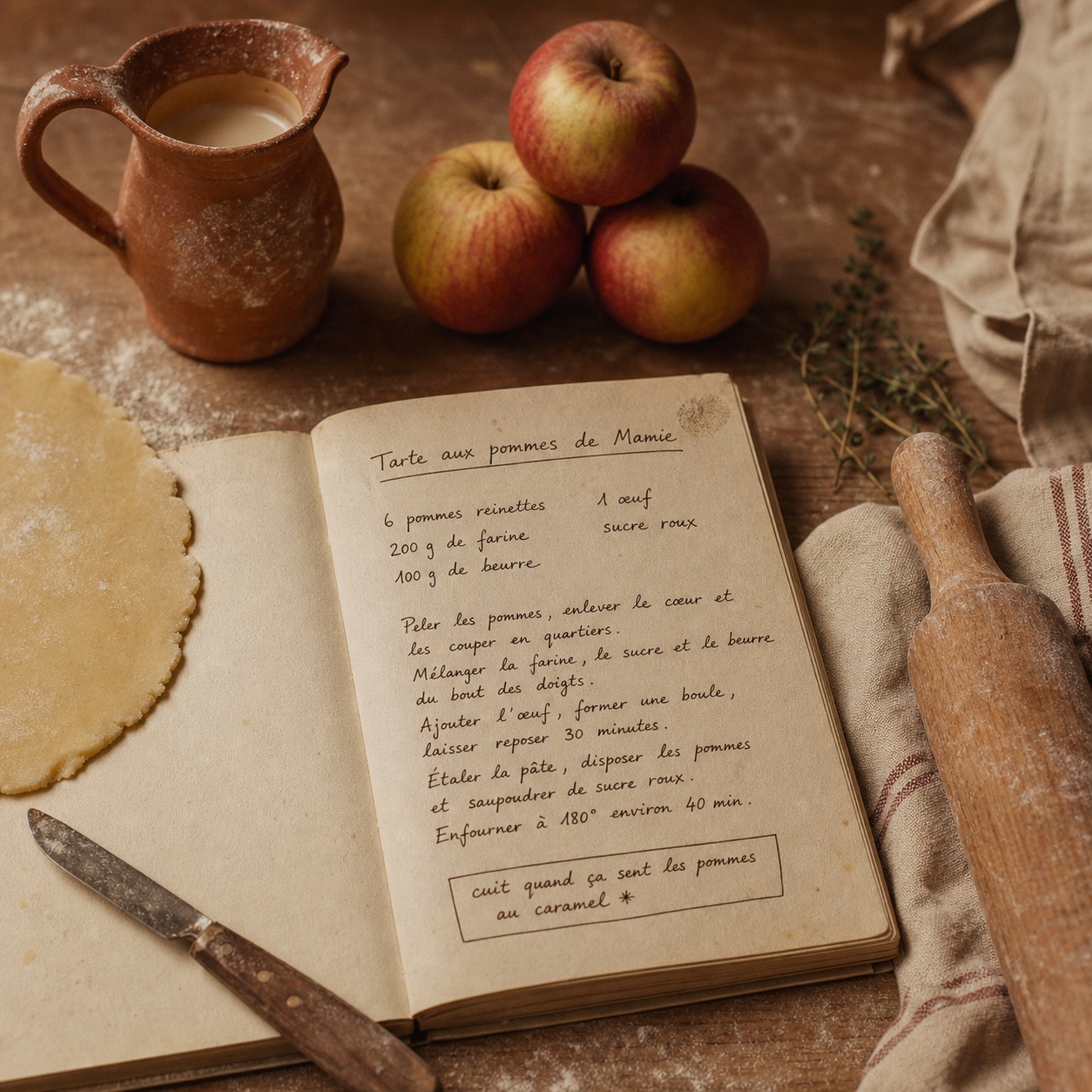
Passing on family recipes: gather, write, keep
Gathering the recipes of a mother, a grandmother, an uncle who cooks well, is one of the simplest, and most precious, projects of family transmission.