Gift ideas ·
Family memory book: what goes in it, and how to make one
A family memory book isn't only a photo album. It gathers what would otherwise drift away: voices, gestures, recipes, anecdotes.
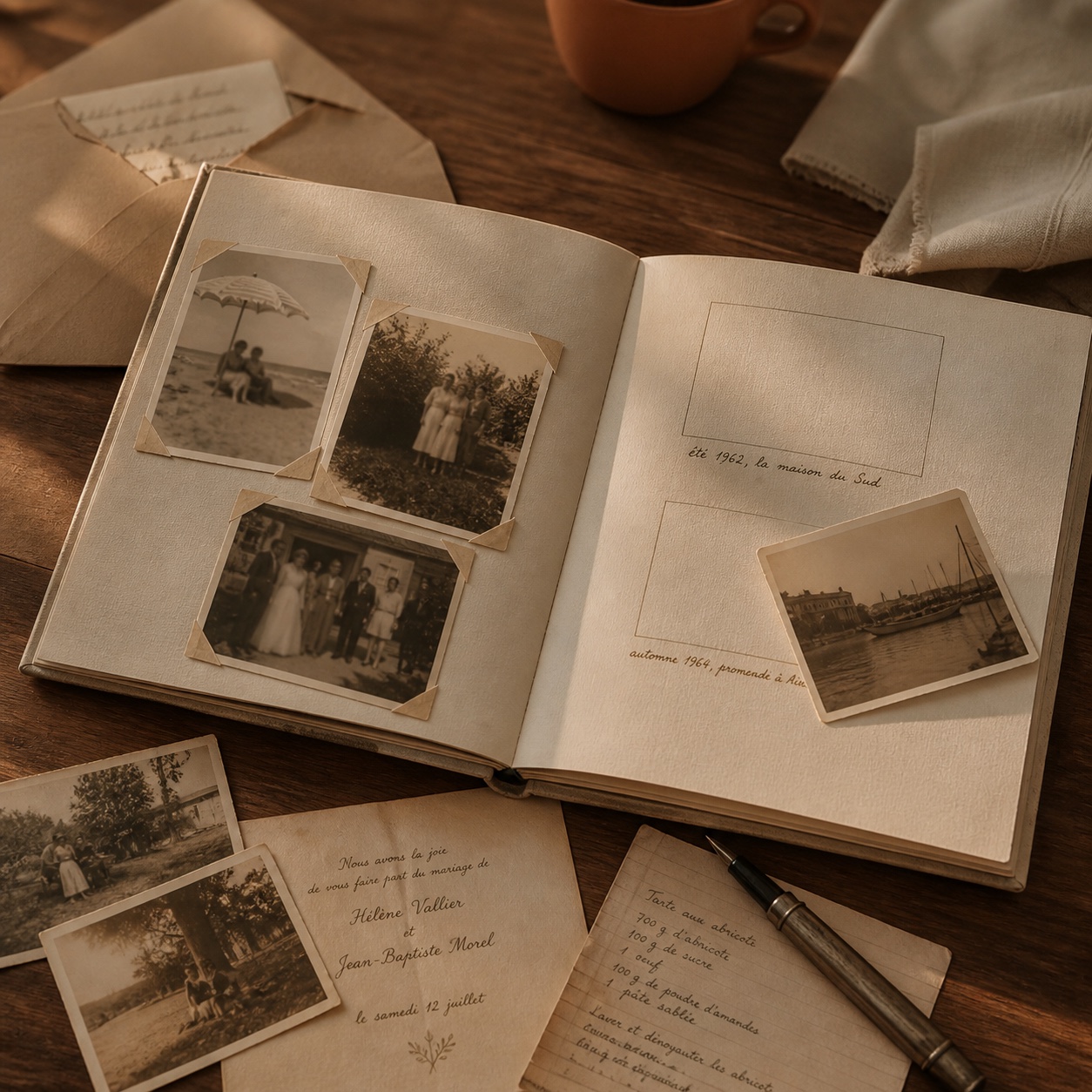
You may have, somewhere at home, a box. Or a drawer. Inside: photos in no order, a postcard from a grandfather, two or three handwritten letters, a wedding menu from 1968, a recipe scribbled on a corner of paper. All you know is that you don’t want to lose any of it. But you don’t quite know what to do with it.
The family memory book is precisely that object: what gathers, organises, and gives shape to what would otherwise stay scattered. This article helps you choose the form that suits your family, and begin.
A memory book, what’s it for
At first glance, you think “photo album”. It’s wider than that.
A family memory book holds together three things:
- Images: photos, children’s drawings, announcements, postcards.
- Stories: anecdotes, letters, transcribed oral testimonies, captions for photos.
- Traces: recipes, songs, lists (of first names, of places, of friends), maps of the houses lived in.
Without that frame, each item stays alone. A photo without a caption is a face that will be forgotten in two generations. A recipe without a name is a dish you’ll no longer know who to cook for. The book is the thread that ties.
Several possible forms
There isn’t one ideal memory book. There are several, and each family can pick its own.
The annotated album. A large photo album, but with a short text facing each image: who’s in the photo, where, when, what they did with their life, what they passed on to you. The work is as much about writing as gluing.
The collected stories. Closer to a book than an album. You choose ten or twenty episodes from family life (the grandparents’ meeting, the move to France, the house in the South, the winter of ‘54), and you tell each on two or three pages. Photos come as illustration.
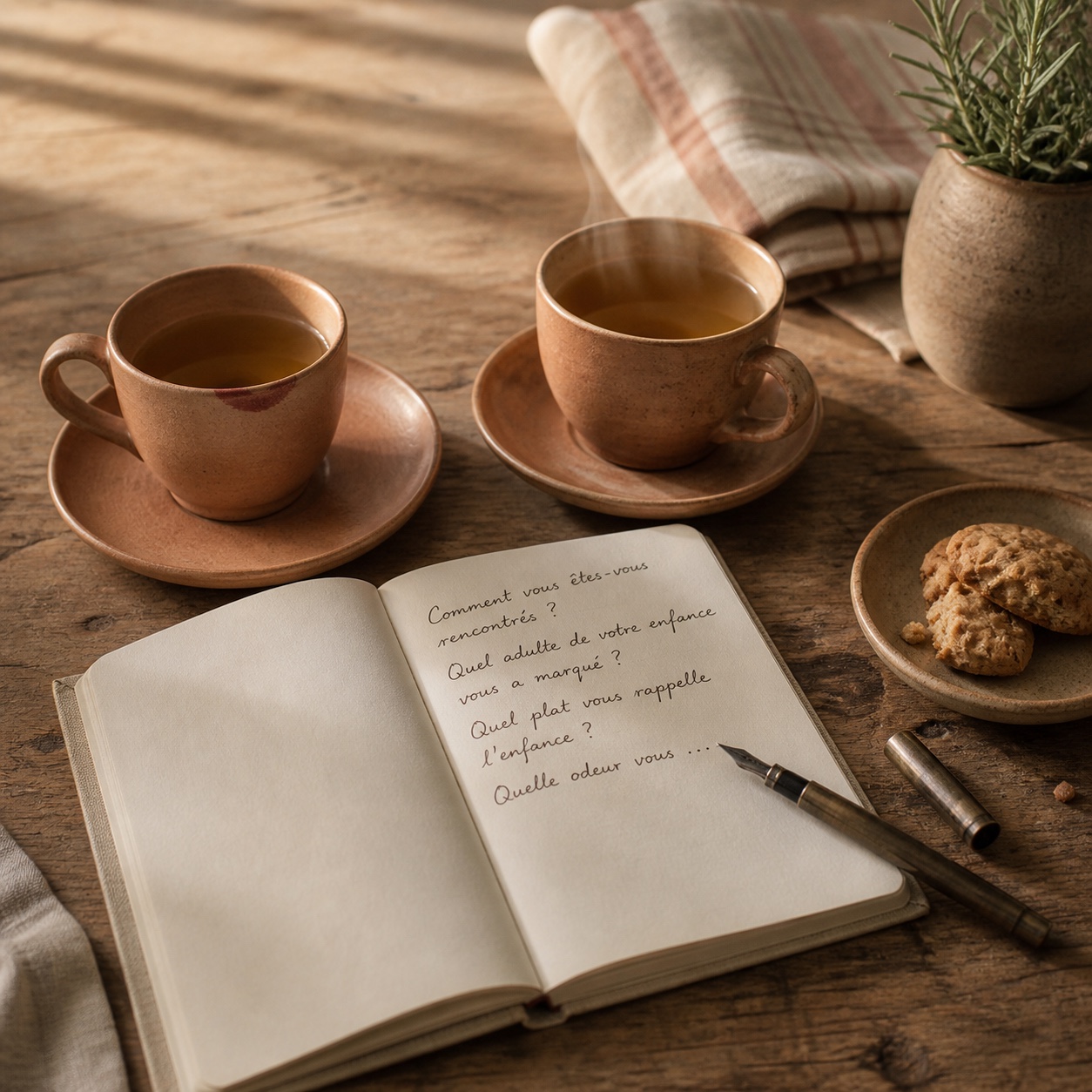
The notebook of questions. You write a list of questions (what’s your earliest memory? what did your grandparents do? which dish brings back childhood?) and each family member answers, at their own pace. At the end, you gather.
The digital object. A file or a service like Carnely lets you include what no paper book can hold: someone’s voice singing, a five-second video, a recipe told aloud. Many families combine: digital to gather, paper for what’s printed afterwards.
How to begin
The most common mistake is wanting to do everything at once. That’s what turns a transmission project into a building site abandoned in a cardboard box.
Step 1, narrow down. Pick one branch, one generation, or one theme. The maternal grandparents’ book. The family house in Brittany. Granny’s recipes. The narrower the scope, the more chance the project has of being finished.
Step 2, gather what already exists. Before writing anything, take out the box. Spread it on a table. Sort by theme, by year, by person. You’ll see what’s missing.
Step 3, collect what’s missing. An afternoon with your mother. A recorded phone call with your uncle. A Sunday asking your father to tell. This is the step that takes time, and that’s worth it.
Step 4, give it form. Only now do you choose the format. Album, collection, notebook, file. Pick what fits what you’ve gathered, not the other way around.
Digital and paper
Many think they have to choose. Rarely necessary.
Digital is unbeatable for gathering. You record a voice, scan a photo, type a story in the evening, share with a distant cousin. Everything stays accessible and editable.
Paper is unbeatable for passing on. A bound book on the mantelpiece is an object you pick up, leaf through, give. It survives changes of file format, services that close, lost phones.
The best practice often consists of using a digital service to gather over time (recipes, photos, voice, letters), then printing a paper version when the time comes, for a round-number birthday or a meaningful Christmas.
For yourself, for those close to you
A question often comes up: am I making this book for myself or for the others?
Both, and that’s what makes it right.
For you: because gathering these fragments means sorting through a family life, putting words on what you hadn’t formulated, rediscovering forgotten faces.
For those who’ll read you: because in ten years, in thirty, these pages will be the only direct link to an era, voices, ways of cooking, ways of loving that would otherwise have left no trace.
A question to start with
If you’re hesitant to begin, take fifteen minutes tonight, and answer one question, in writing:
Which family photo do I hold dearest, and what do I really know about what it shows?
The answer will give you, almost always, the first chapter.
Going further
To help your loved ones begin to tell, you can lean on questions to ask your parents. And if you’re looking more broadly for a gift in the same intent, this article offers several directions.
Related reading
Passing on
Questions to ask your parents: what makes the difference
The right questions to ask your parents aren't always the ones you'd expect. Here's how to open the conversation, and thirty directions across major themes.
Gift ideas
Original gift ideas for parents: stepping off the beaten path
Why gifts for parents become harder to choose with time, and three ideas to offer something that truly looks like them, without falling into the usual clichés.