70th birthday gift ideas: beyond the usual choices
Seventy is neither a peak nor a heavy threshold. It's a beautiful decade opening. The right gift accompanies the years to come, rather than crowning the ones gone by.

Seventy is a birthday of its own. Not quite the heavy step of eighty, no longer the lightness of sixty. The person being celebrated has, in most cases, energy left, perspective, free time, and the awareness that these three things are not guaranteed forever. It’s a rare window.
It’s also a birthday where you publicly offer a gift to someone who could, in theory, buy themselves almost anything. So the question is not how much to spend, it’s what to offer that takes that singularity into account.
Here are a few directions to step beyond the engraved watch and the gift card, without falling into solemnity.
Seventy, a birthday unlike the others
At sixty, most people are still largely inside the life before: often working, in the rhythm of children turned young adults, in a form of continuity. At eighty, the story shifts: the body asks more often, the stakes narrow. Between the two, seventy is a decade that opens, still mobile and active, where one starts to ask what to keep, what to pass on, what to begin.
This particularity should guide the gift. It’s neither an end-of-career trophy, nor a threshold consolation. It’s an accompaniment.
The usual gifts, and why they miss
Before suggesting directions, here are the ones to avoid, and why.
- The watch or the jewel engraved with “70”. The intent is touching, but the object freezes a number. It reminds the person of their age each time they glance at it. Many people would rather not be reminded.
- The gift card from a major chain. Practical, but without intent. The person will spend it within the month and have no particular memory of who gave it.
- The large bouquet. Beautiful on the day, faded by Tuesday. The gesture passes entirely.
- The surprise luxury weekend. Good intent, but short. And many people in their seventies dislike being organised without having a say.
- The expensive decorative object. A box that’s opened, placed on a shelf, and never touched again. At seventy, more than ever, one declutters.
None of these gifts is bad in itself. They miss because they are interchangeable: they could have been offered to someone else, by someone else, without changing much.
What people in their seventies say they want
When you listen to them (and we did, in preparing this article), three things come back.
First, time with the people close to them. Not a formal dinner, more regular moments ahead. A monthly meeting, a trip planned six months out, the promise of an annual family gathering.
Then, something that looks like them. Not a generic object, but one thought through for them precisely: a book they’d have loved, a piece of craft from a place that means something to them, a wine from the year of their birth.
Last, a sign that you’re interested in what they’ve lived. Not a family interrogation, more an open door: a notebook to write in, a recording to make together, an organised visit to the places of their youth.
The right gift sits in one of those three families.
Three directions for objects that last
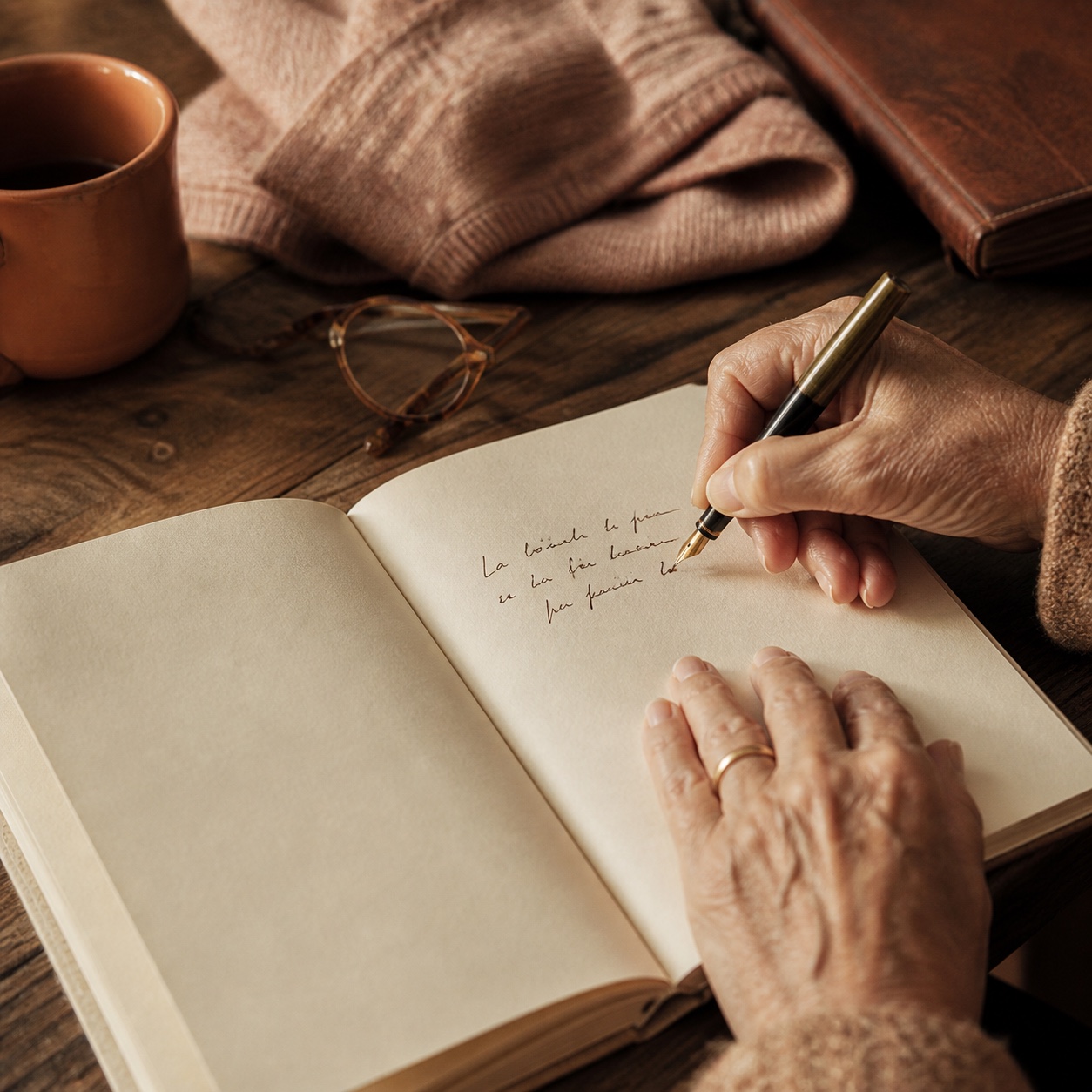
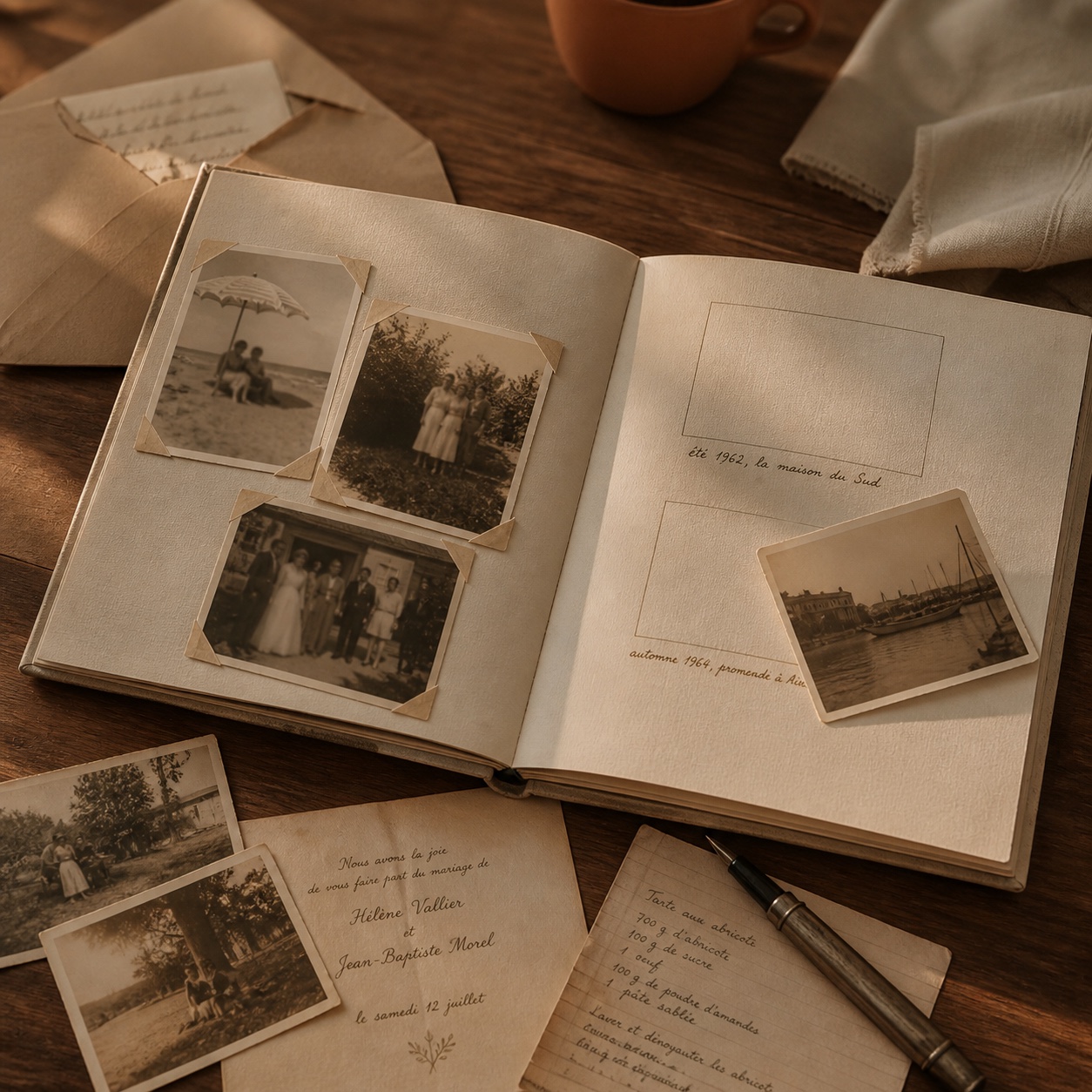
1. An object that fills up over time. An album to complete with photographs from the year ahead, a beautiful notebook to write down what passes, a bound book to fill month by month. What sets this kind of gift apart is that it begins on the day of the birthday instead of ending there.
2. A meeting, not an object. A subscription to a concert season, a course running over six months (painting, language, writing, gardening), a museum pass, a promise of a trip to come. The point: to create dates in the calendar rather than a brief vibration on the day itself.
3. A precise domestic attention. A wine from the year of birth (1956 for a seventieth in 2026), a book signed by an author they admire, a piece of pottery from a local craftsperson, a hamper of products from a region they come from. These gifts say: I know you, I didn’t pick up the first thing in front of me.
Offering an object that gathers
The first direction deserves to be unpacked, because it shows less.
At seventy, many people start to feel that part of what they’ve lived has never been said. Not out of drama, simply because the pace of life didn’t lend itself to it. Family conversations turn on recent news, on the children, on health. Nobody asks your mother what it was really like to be twenty-five in 1981, and nobody will spontaneously.
Offering an object that gathers (a notebook to fill, a guided memory book with questions, a service like Carnely that asks the questions one by one) opens that door without forcing it. The person writes when they want, what they want, for whom they want. No duty. A possibility.
The gesture works particularly well when it comes:
- From an adult child: the implicit message is what you’ve lived interests us, and we don’t want to wait to know.
- From the grandchildren, organised by a parent: the message becomes your grandchildren want to know you otherwise than through us.
- From a partner: rarer, often very fitting, I’d love to read you differently.
Presenting the gesture
The tone of the giving counts as much as the object. Avoid defensive humour (“enjoy before…”), crushing solemnity, any phrase that reminds the person of their age.
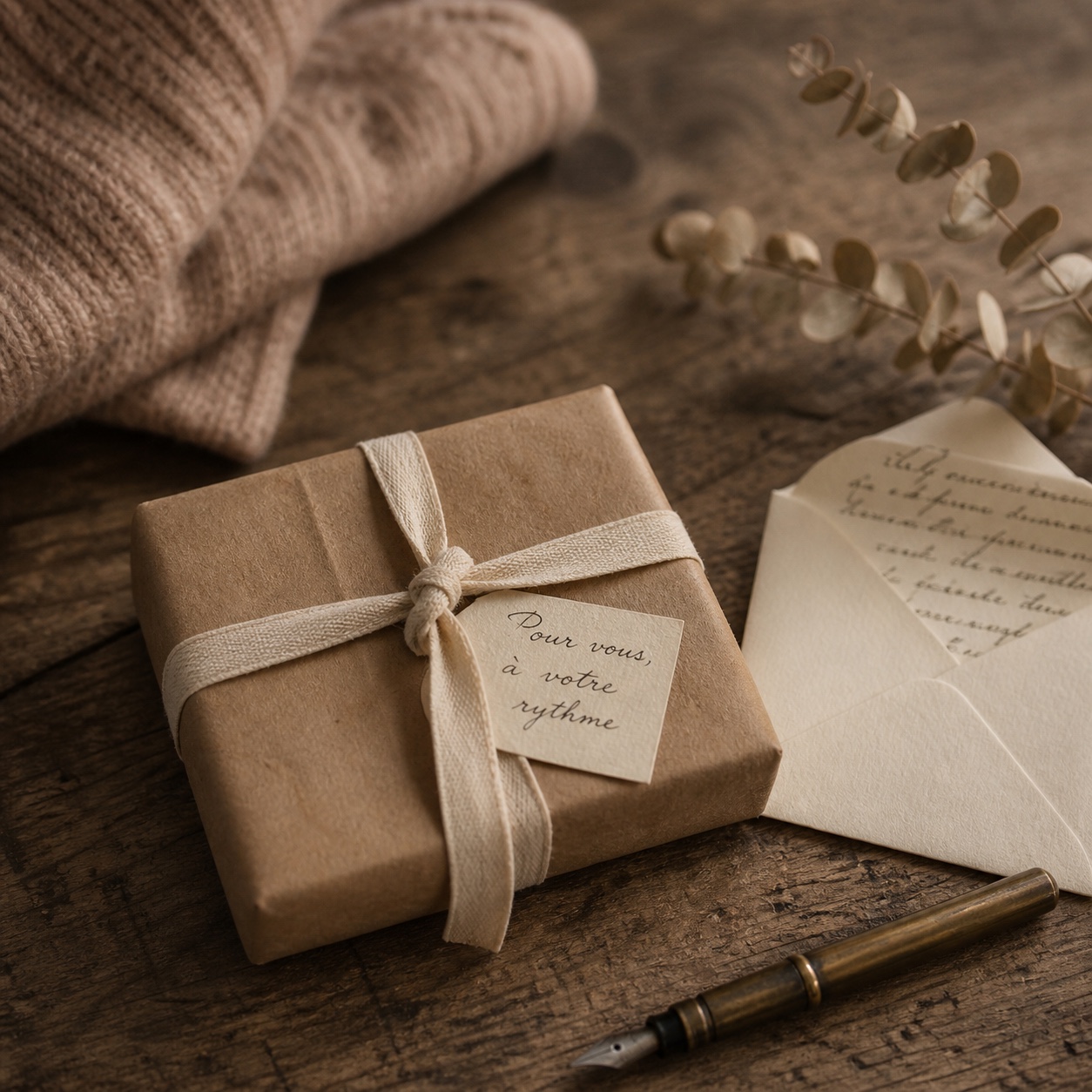
A short line, handwritten if you can:
“Here’s a place for what you’d like to keep. At your own pace. Nothing to hand in. It’s for you.”
The “for you” is central. Many older people quickly feel obliged to those close to them: I should fill this notebook, show them excerpts, make them happy. Lifting that obligation, right at the giving, changes everything over time.
Special cases
Joint sibling gift. Either coordinate a collective envelope where each of you slips in a handwritten letter (powerful), or fund together a more ambitious gift none of you would attempt alone (a trip, a long course, a subscription). Avoid the soft middle: an anonymous co-funded object with no words.
Gift from a partner. Prefer sobriety to spectacle. A promise of a project started together (a garden redrawn, a trip planned for the year), with a modest but well-chosen object, beats a piece of jewellery that sleeps in a box.
Gift from the grandchildren. A handwritten letter from each grandchild, slipped into the same envelope, is worth more than any object. If the children are young, a captioned drawing does the job.
A question to decide by
Before finalising your choice, ask yourself: in two years, when this person opens their cupboards, what will they be glad to find again of this gift?
If the answer is “an object that serves no purpose but reminds me of that day”, you may have missed it. If the answer is “something I used, wrote in, shared, that kept me company”, you’re there.
Going further
If you’re looking more broadly for ideas for your parents, this article gathers several directions. If the person turning seventy is also retiring this year, here are three directions for a retirement gift that lasts. And if you lean toward an object that gathers, here’s what to put in a family memory book, and how to go about it.
By

Carnely's journal is kept by Pierre Goux, co-founder of Carnely. Articles on choosing and sharing what matters with the people close to you.