Gather ·
A group trip photo album worth coming back to
The trip photos are scattered across five phones and the group chat is fading. What you actually want: the best from each person, with the stories, in one place.
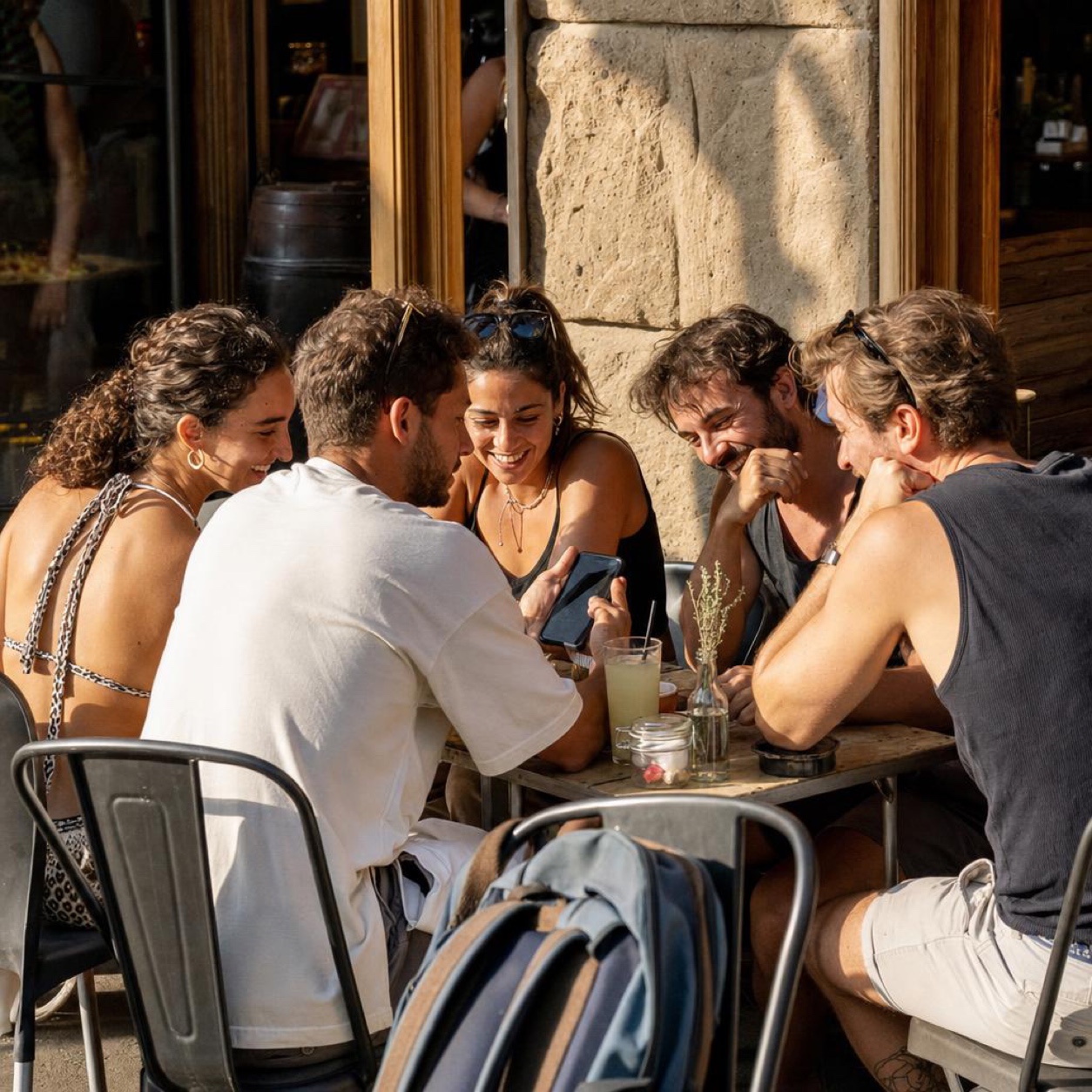
You got back on Sunday. The trip was everything you hoped, and the group chat is still going: the best photos get passed around, someone promises to put everything in one place one of these days. You know what happens next, because it is always the same. The messages thin out, the chat goes quiet, and the photos stay where they were born: scattered across five phones.
The scenario is so common that it feels inevitable. It is not. Gathering everyone’s photos takes very little, as long as you separate two different gestures: piling everything into one place, and keeping together what matters. This article looks at why the two usual reflexes, the chat and the shared folder, lose the photos, and what works instead.
The trip group chat always goes quiet
During the trip, the group chat is irreplaceable: it is where you find each other, lose each other, and send the photo of the table before everyone arrives. It is afterwards that things fall apart, for three precise reasons.
The first is technical: messaging apps compress images. The sharp photo taken at sunset lands in the thread as a reduced copy, and that copy is often the one everyone saves without knowing it.
The second is structural: a thread scrolls. Finding the photo from the second evening, three months later, means climbing back through hundreds of messages between two logistics conversations. The content exists, but the place was never built for returning.
The third is human: a trip chat has a lifespan. Three weeks, sometimes two months. Then it falls asleep, and everything it carried falls asleep with it. Nobody is at fault: a conversation thread was never a memory.
The shared folder nobody opens again
The other reflex is to create a shared album or an online folder where everyone is supposed to drop their photos. On paper, it is the right idea. In practice, two things happen, often both at once.
First, only one person feeds the folder: the one who created it. The others mean to get to it, then life resumes. Second, when everyone does play along, the result is almost worse: 1,800 photos with no order and no selection, the bursts, the duplicates, the blurry restaurant shots. Nobody reopens a folder of 1,800 photos. It was built for reassurance, not for returning.
A pile is not a memory. It is a warehouse, and warehouses get no visitors.
What you actually want after the trip
Look closely at what is missing after a trip, and it is almost never “all the photos”. It is three more precise things.
The photos from the others, first: the ones you are in, since you do not photograph yourself. What you did not see, next: the morning market you skipped, the colour of the harbour before the storm. Each person lived a slightly different trip, and the same moment exists in several versions: the early riser’s, the one who photographed every meal, the one who took no photos at all but remembers everything.
And then the stories. A photo without its story falls silent within two years: nobody remembers why everyone was laughing, or how you ended up on that boat. What you want to keep from a trip fits in one sentence: the best from each person, told.
The method: ten photos and two stories each
In practice, the gesture takes three steps, and it is shorter than it looks.
- Each person chooses about ten photos. Not fifty: ten to fifteen. The constraint is not a restriction; it is what gives the whole its value. Sorting your photos takes ten minutes when you are looking for the best ones, not when you are hesitating over nine hundred.
- Each person puts them in the same place, somewhere stable, outside the conversation thread, where the images arrive at full quality.
- Each person tells two or three moments they were the right witness for. A few lines are enough: who was there, what happened just before, why the moment still stands. It is the part no shared folder ever asks for, and it is the part that changes everything.
With five people, that makes about fifty chosen photos and a dozen stories. A whole trip, readable in a quarter of an hour, that makes you want to return to it.
A place that outlasts the group chat
That leaves the question of where. The criteria are simple: private, because the trip is only the business of the people who took it; no scrolling feed; easy for everyone to enter through a single link; and durable, so you find it intact two years on.
That is the frame a Carnely chapter offers: a private space opened for the trip, where each person enters through a link, puts down their chosen photos and tells their side. No feed, no counters, no ads; the chapter stays, long after the chat has gone quiet.
The principle holds beyond any tool. A trip with friends deserves better than a dead thread and a warehouse of images: a place where the best from each person is gathered, with the stories that carry it.
Going further
The same mechanics play out in families: the family WhatsApp group promises to bring everyone together, and swallows everything. And if you want to go beyond the images, writing your summer memories shows how a few lines hold what no photo carries.
By

Carnely's journal is kept by Pierre Goux, co-founder of Carnely. Articles on choosing and sharing what matters with the people close to you.