Share ·
Writing summer memories: what doesn't fit in a photograph
A photograph keeps the face, not the voice. Not the smell of warm pine. Not the sentence spoken that evening, walking. Here's how to write a summer memory so it stays.
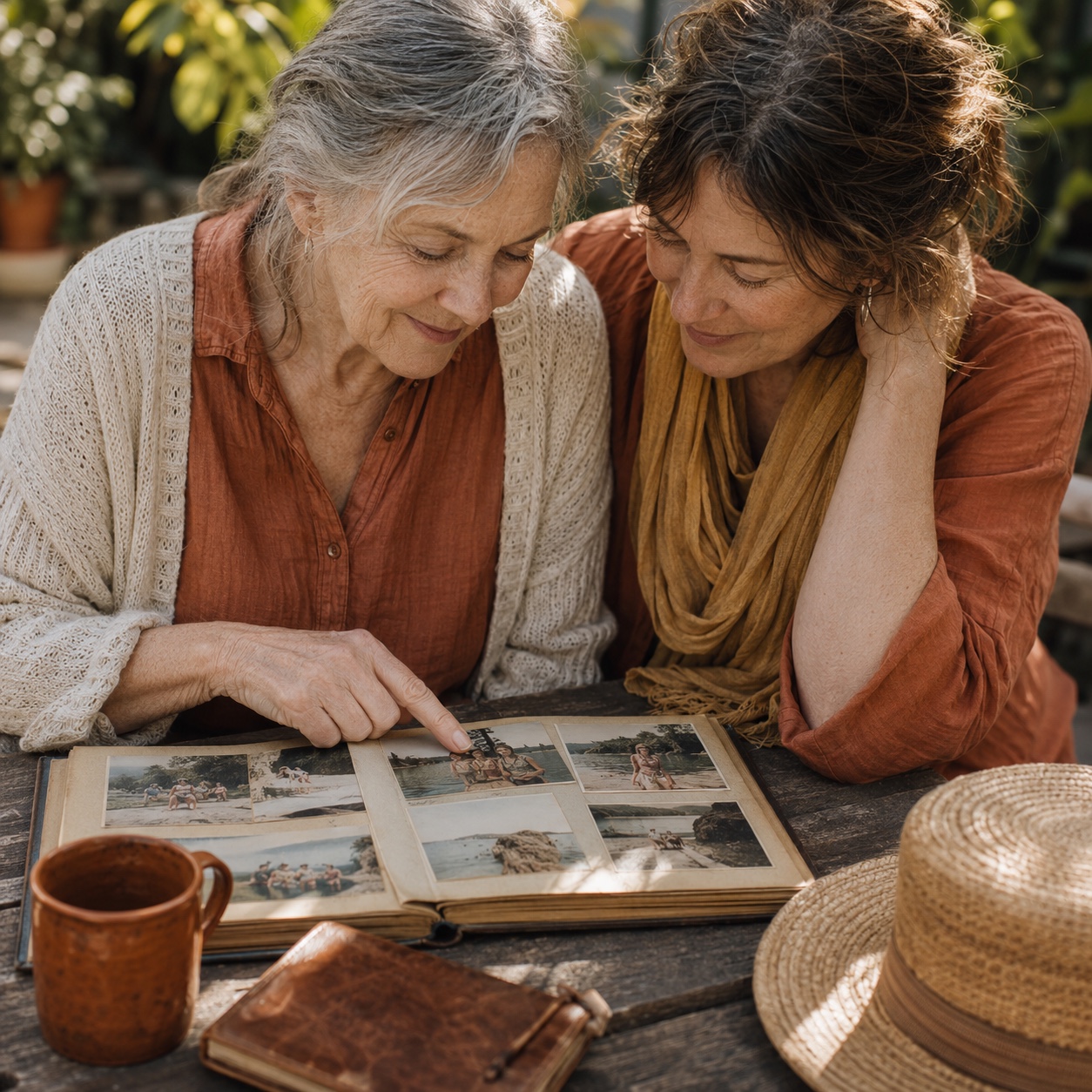
There are summers you only have photographs of now. You scroll through them on a screen, sorted by year, and something quietly bothers you without your knowing what. Everything is there. All the landscapes. All the faces. And yet the summer itself doesn’t come back.
What’s missing in the photo is exactly what made the summer. The smell of warm pine at the end of the afternoon. The sound of the shutter you lowered before the nap. The sentence your father said, on the seawall, looking out at the horizon. No camera captures that. No phone records it.
This article suggests another way to keep a summer: not to file a travel report, but to write, after the fact, what the photograph leaves out. At your own pace, from your own home, on the summers that matter.
The photograph stops at the face
Holiday photography captures the scenery and the faces admirably. It captures almost nothing of the timing, the sensation, the tone.
A photograph says where. It doesn’t say what it was like. It doesn’t say the warmth of the stone when you sat on it, the particular colour of the light in the evening, the silence that fell after lunch. It doesn’t say what you thought without speaking, looking at the scene.
That’s why ten thousand holiday photographs end up looking alike, when no two summers are truly the same. The difference between two summers doesn’t lie in what you saw. It lies in what you lived around what you saw.
What you’ll write on your return
Many people imagine writing about a holiday as a logbook kept on site. That works for a few. For most, it doesn’t: you don’t write on the beach, you don’t write in the car, you don’t write in the evening when you’re tired.
The writing of a summer is better done afterwards. Three days, three weeks, three months after the return. From the calm of home, when the memory has already settled and only what matters remains. You’re not writing a chronology. You’re writing what surfaces.
That’s one of memory’s quiet strengths: it sorts on its own. What you’ll remember of a summer in September isn’t what you noted down in August. And it’s precisely that sorting that deserves the page, because it tells what really happened.
Three points of entry
To avoid writing too wide, choose a precise entry. Three almost always work.
A gesture. A gesture your mother made on holiday, a gesture your father repeated every morning, a gesture of your own you only made there. My father always checked the shutters twice before coming down for his coffee. The gesture fits in two sentences and tells a whole man.
A silence. A moment that summer where no one was speaking, and where something passed all the same. On the afternoon of the fourteenth, in the living room with the shutters closed, my mother was reading, my father was sleeping, and I think it’s the most peaceful memory I have of them together. Silence can be described too. Often better than conversations.
A smell, a sound, a taste. The smell of the house when you opened the door on the first day. The sound of gravel under the tyres. The taste of the neighbour’s garden tomatoes. Those memories go first. Writing them fixes them.
Pick one for this particular summer. Not three. One. You’ll come back to the others later, if the wish is there.
For yourself, or for those who matter
You can write your summer memories for yourself, plainly, with no reader in mind. That’s reason enough. The act of writing fixes the memory, even when no one else will read it.
But those pages are also among the most precious to pass on. Your children don’t know what it was like, the summer at your parents’ house in 1978. Your grandchildren won’t know either, the summer at your house in 1995, unless someone writes it down.
You can write one page per childhood summer you can recall. You can write for your children what they don’t know of your summers from before them. You can write for your grandchildren what summer was at your house when they were still very young. Each page takes fifteen minutes, and each one tells a whole era.
Other people’s summers
Another path: writing other people’s holidays. Not yours, but those of your parents, of your grandparents, as they told them to you.
If your parents are still around, ask them. Not an interview, just a question dropped at the end of a lunch. What is the summer you remember best? Let them speak. Note down that same evening, in two or three sentences, the tone, the precise anecdote that came out.
After a few summers, you’ll have gathered what no one else in the family has gathered. Things your parents never told your siblings, because no one ever asked the question.
One page per summer
Writing about summers takes well to a quiet ritual. One page a year, written on the return, about the summer just ending or about an old one that has come back up.
After ten years, you hold a decade of summer memory. After twenty, you hold something no photo album could ever tell. And the value of that series rests on regularity, not on literary polish.
Some keep a paper notebook set aside for this, drawn out each September. Others use a digital frame like Carnely that asks one question at a time and keeps the pages from one year to the next, accessible to those you’ve chosen, when the time comes.
A question for this summer
Before closing this article, ask yourself: which is the summer I’ve never told anyone about? That’s almost certainly the one to write first.
Going further
If you’d like to go deeper into writing sensory memories (smells, sounds, gestures), here’s how to keep what fades first. And if you’re writing for the longer term, for those who matter to you, here’s where to start writing your life story.
By

Carnely's journal is kept by Pierre Goux, co-founder of Carnely. Articles on choosing and sharing what matters with the people close to you.