Share ·
How to write a family biography without becoming a writer
A family biography isn't written in one sitting, nor by one person. It's a shared notebook filled by questions, over several months, with several voices.
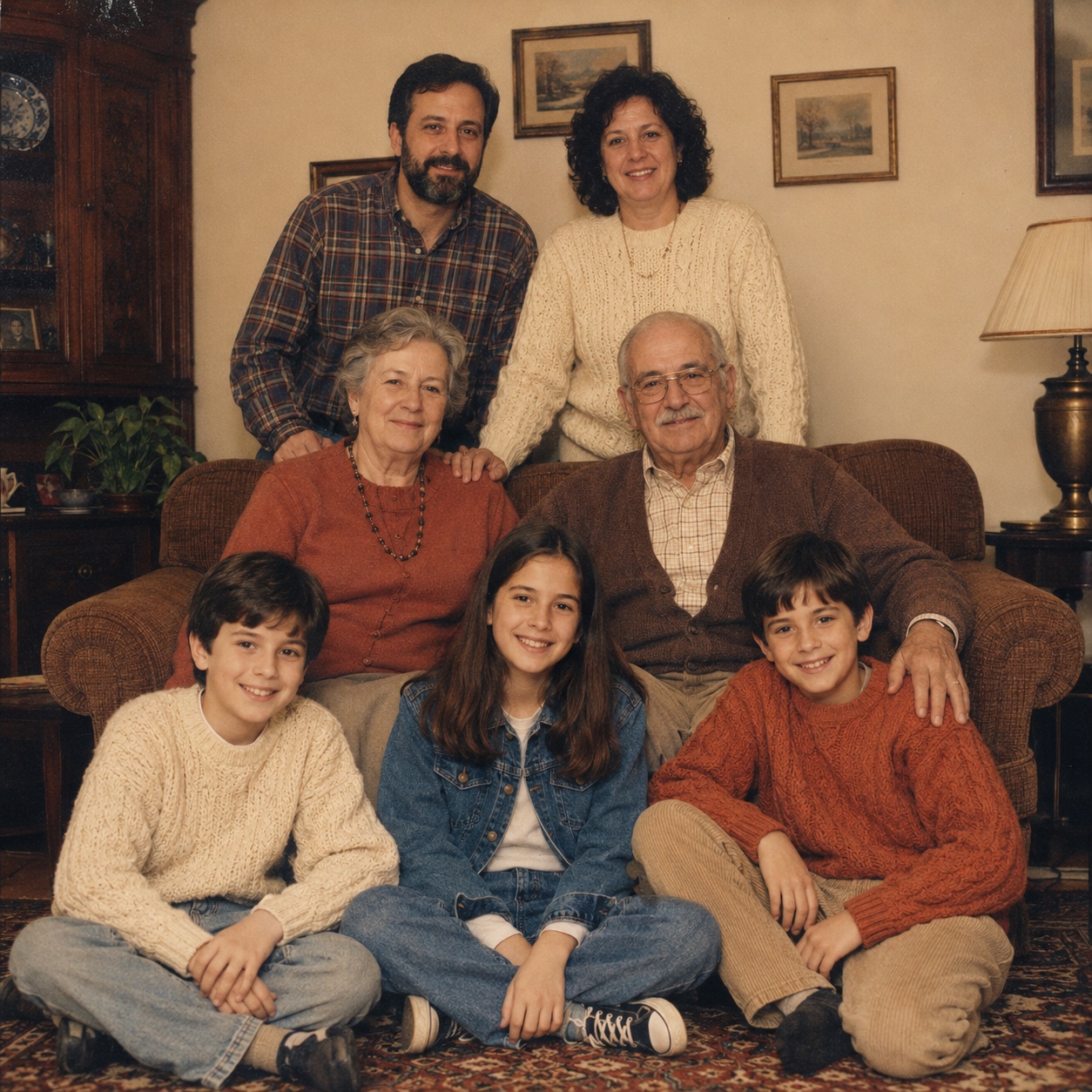
Writing your family’s biography isn’t writing a book. It’s filling a notebook with fragments, over several months, with several voices, starting from concrete questions. You can begin tonight, without a plan, without a family tree, without a writer’s talent.
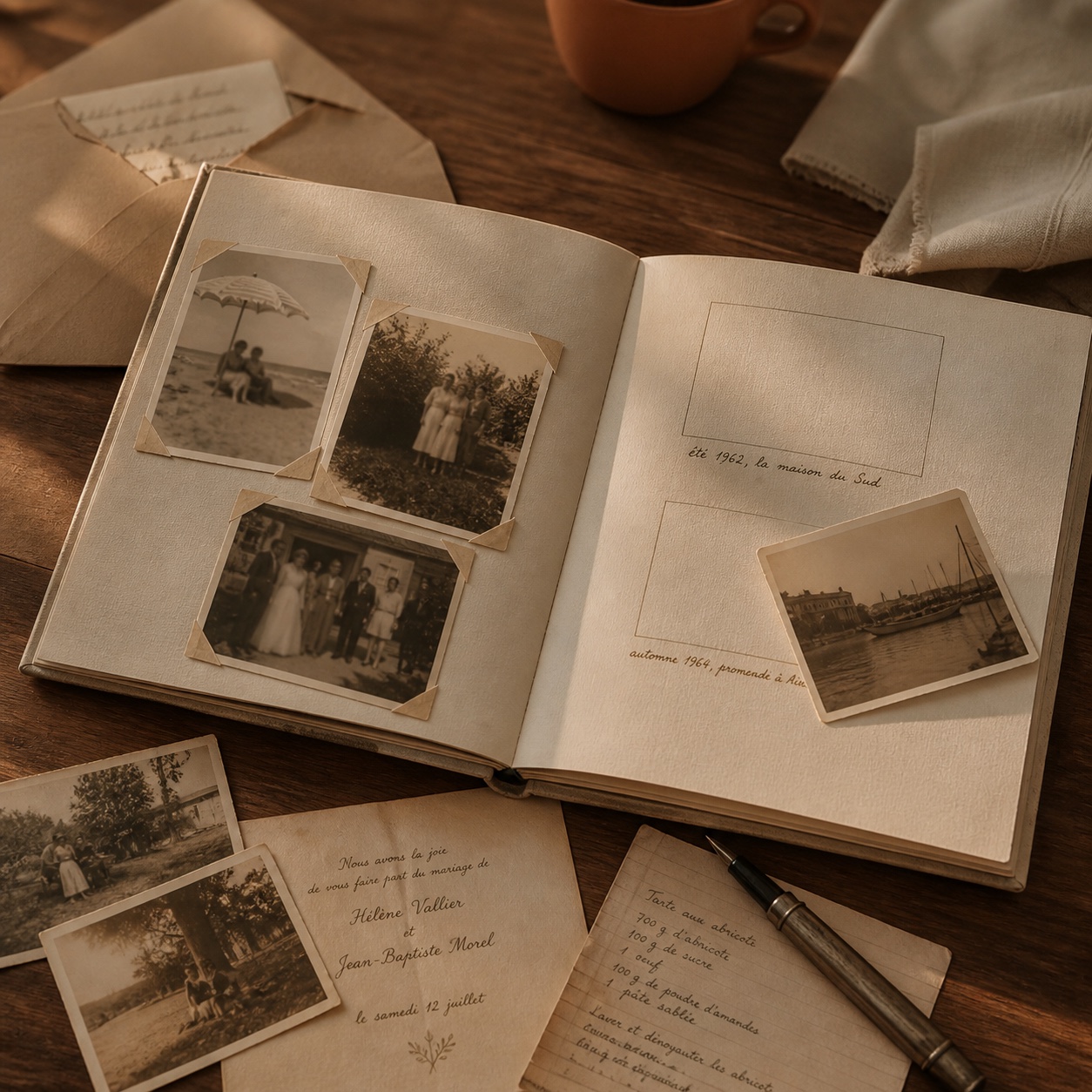
Many people, looking at old family photographs on a Sunday afternoon, feel a wish rising they don’t quite put into words: to write down what happened in this family. Not their own life. The lives of everyone standing in the photographs: the grandparents they barely knew, the cousins they no longer see, the migration stories they half-listened to, the recipes they never asked for.
Then the false idea arrives: it would have to be a book. Beautifully made, structured, with chapters and a family tree on the opening pages. The project feels too big. So nothing gets written. This article offers another way.
A family biography isn’t a collective autobiography
Two projects often get confused; they should be kept apart.
Your memoirs tell your life. One voice, one gaze, one thread. It’s an intimate and precious exercise, with its own logic. Another article in the journal explains how to begin.
A family biography tells something else: what moves between the generations. The house everyone returned to in summer. The grandmother you only knew as a child. The 1962 move. The brothers people rarely talked about. You’re not the subject; you’re the archivist, the investigator, sometimes the scribe writing on behalf of others.
This difference changes everything. You don’t need to know all of it before you start. You need to ask questions and write down what comes, yours and theirs.
Start with questions, not with the tree
Many people attack the family tree first. Names, dates, places, parent-to-child. It’s tempting because it looks orderly, and completely disappointing to the eventual reader, who ends up facing a page of civil records with no flavour.
The tree can come later, as an appendix. What gets read are the episodes. What gets passed on are the anecdotes, the explicit silences, the sentences that came back around the table.
A good family biography starts with a simple question, asked of yourself or of a relative: what changed between my grandparents’ generation and ours? Or: what was the great pivot in my family, a war, a departure, a marriage, a secret? The opening question dictates what follows.
Five concrete entry points
Rather than looking for a plan, pick one entry point. One, to begin with.
- A family object. A watch, a tea set, a piece of furniture that followed three moves. Where does it come from, who carried it, who will want it next? An object unfolds three generations in two pages.
- A house. The summer house, the childhood house, the house that was sold. Describe the rooms, and each room will bring back a memory, a character, a use.
- A dish that keeps returning. A grandmother’s recipe, the Sunday meal, the birthday cake always made the same way. The dish is a thread; you pull on it, and the family follows.
- A displacement. A migration, an exile, a move, a grandfather’s military service. Displacements are thresholds; they cut a family history into a before and an after.
- A specific event. A wedding, a birth, a memorable family reunion, a birthday celebrated three times. From a single scene, you can draw five people and three decades.
Pick the one that resists you the least, and write for twenty minutes on it. You’ll see what comes.
Gather several voices without blending them
A family biography written by one person stays a personal testimony about the family. Good, but narrow. As soon as you can, gather other voices.
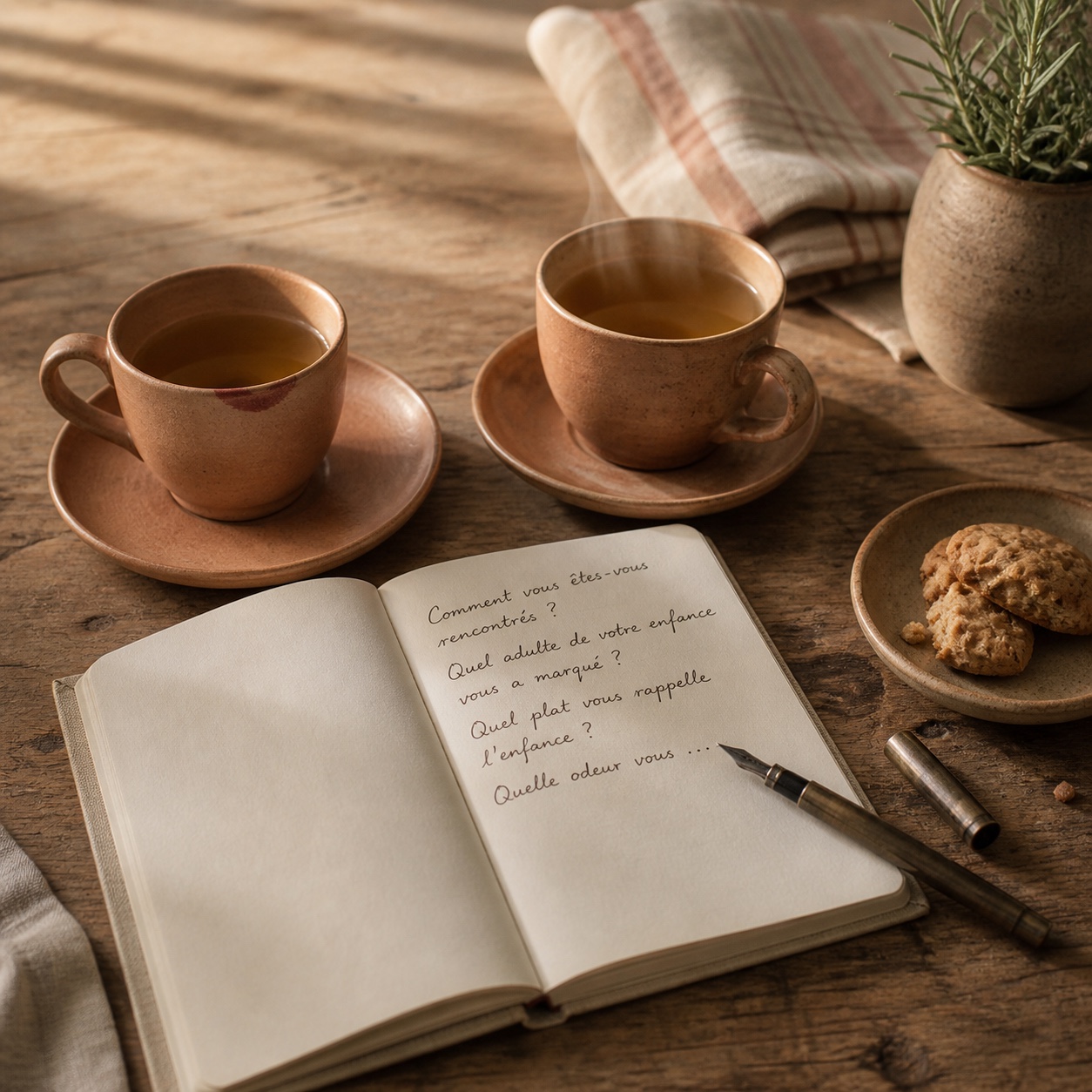
In practice: call a parent, an uncle, a cousin. Ask two or three precise questions (not tell me your life, which gets nothing). Record if the person allows it, or take notes. Then, in the family notebook, render what they said while keeping their tone. Don’t smooth it. A slightly awkward sentence from your aunt, quoted as is, is worth ten reformulated paragraphs.
Mark the voices. A change of colour, an indent, a mention of the speaker. Anyone reading the notebook should be able to say that, my aunt Helen said it, and not that, the family agrees on. An honest family biography keeps the disagreements visible.
Working with what you’ll never have
At some point, you’ll hit gaps. A period nobody talked about. A great-uncle no one ever knew. A secret half-glimpsed without confirmation. A whole branch you’ve lost track of.
First rule: don’t fill with invention. A family biography isn’t a novel. If you don’t know, write it: ‘We don’t know why Albert left the house in 1948. None of the three children could explain it; my mother thought it was because of a quarrel, but she wasn’t sure.’ That sentence is worth more than any plausible reconstruction.
Second rule: a gap is information. If the whole family refuses to talk about a period, that itself is data. The family notebook says ‘on that year, the silence is complete’, and that’s right.
What final form to choose
A family biography doesn’t have to end up as a bound book. Several forms hold up.
- A box. A physical folder with photographs, old letters, interview transcripts, copied recipes. The box is sober, and it survives the upheavals of digital formats.
- A shared folder. A digital document that several family members can add to over time. Light, alive, but fragile without someone tending to it.
- A structured notebook. A dedicated paper notebook, or a digital book like Carnely, that asks the questions one by one and shares each fragment with the people you’ve chosen, starting today. Useful when the project has to last and survive across several computers.
- A book, if you really must. Much later, when the material is there. Not before. The book is an object for the end of the journey, not the beginning.
Pick the lightest form that won’t discourage you. The worst enemy of the family biography is the over-ambitious project that stops after three weeks.
One question to begin tonight
Before closing this article, ask yourself one question, and write two paragraphs in answer:
What is the one family story you’d most like to tell the people close to you, and that no one has written down yet?
You’ve just written the first page of your family biography. The second will come next Sunday.
Going further
If you now want to get your parents telling their stories, here is a list of questions to ask them. And if you sense that what you’re writing might take the shape of an object to give, this article describes the possible forms of a family memory book.
By

Carnely's journal is kept by Pierre Goux, co-founder of Carnely. Articles on choosing and sharing what matters with the people close to you.