Share ·
Passing on family recipes: cook, write, share
The recipe of a mother, a grandmother, an uncle who cooks well is living know-how: it's passed on by cooking together, and by writing down the gesture as much as the quantities.
You may have already tried. Asking your mother for her gratin recipe, your grandfather for his marinade, your aunt for her pastry. The answer almost always comes in the same form: “I put some, I stir, I taste, I add a bit.” And you leave without having noted much.
Family recipes resist the page. That’s because they don’t live on paper: they live in someone’s hands, and they’re passed on as know-how, by cooking together. This article offers a concrete way to let a recipe travel from one pair of hands to the next, and to write it in a form you, your children or your nieces and nephews will actually use, starting with the next meal.
A recipe is more than a list
When you type gratin dauphinois into a search engine, you find a thousand recipes. None is your grandmother’s. Not because she invented anything (she often followed plain conventions), but because she had her way. The lid set halfway through cooking. The garlic clove rubbed into the dish. The “much more than that” of cream when in doubt. The cooking finished by ten minutes in the off oven, door open.
That’s what doesn’t fit on the page: not the list of ingredients (that, you can find anywhere). The gesture. The adjustment. The knack that makes the family version different from all the others.
Writing down a family recipe means doing two things:
- Noting what’s measurable (ingredients, proportions, times).
- Noting what isn’t (gestures, sensory markers, exceptions, context).
Passing on family recipes starts in the kitchen
Three approaches work, depending on your family.
Cook together. It’s the best way. You ask your mother, your father, your grandmother, to make the recipe with you. You get your hands in the dough, you note as it goes, or you film with the phone laid on the worktop. You see the gestures. You hear the hesitations. You understand when the marker is “it should make a blop” and not “two minutes”.
Have them tell. If cooking together isn’t possible, sit down with a notebook or a recording phone. Ask: “how do you do it, exactly?” And let them. The person will describe, hesitate, correct themselves. Note everything, including hesitations: they’re clues.
Ask in order to cook. State the project plainly: “I want to remake your recipe next Sunday and I want it to be like yours. Can you walk me through it?” The prospect of cooking right away frees up much more than the promise of a book.
And the know-how travels both ways. The sauce your friends keep asking for, the dish you perfected during your student years, deserve the same sheet: a family recipe is also the one taking shape right now.
Writing down what lives in the gestures
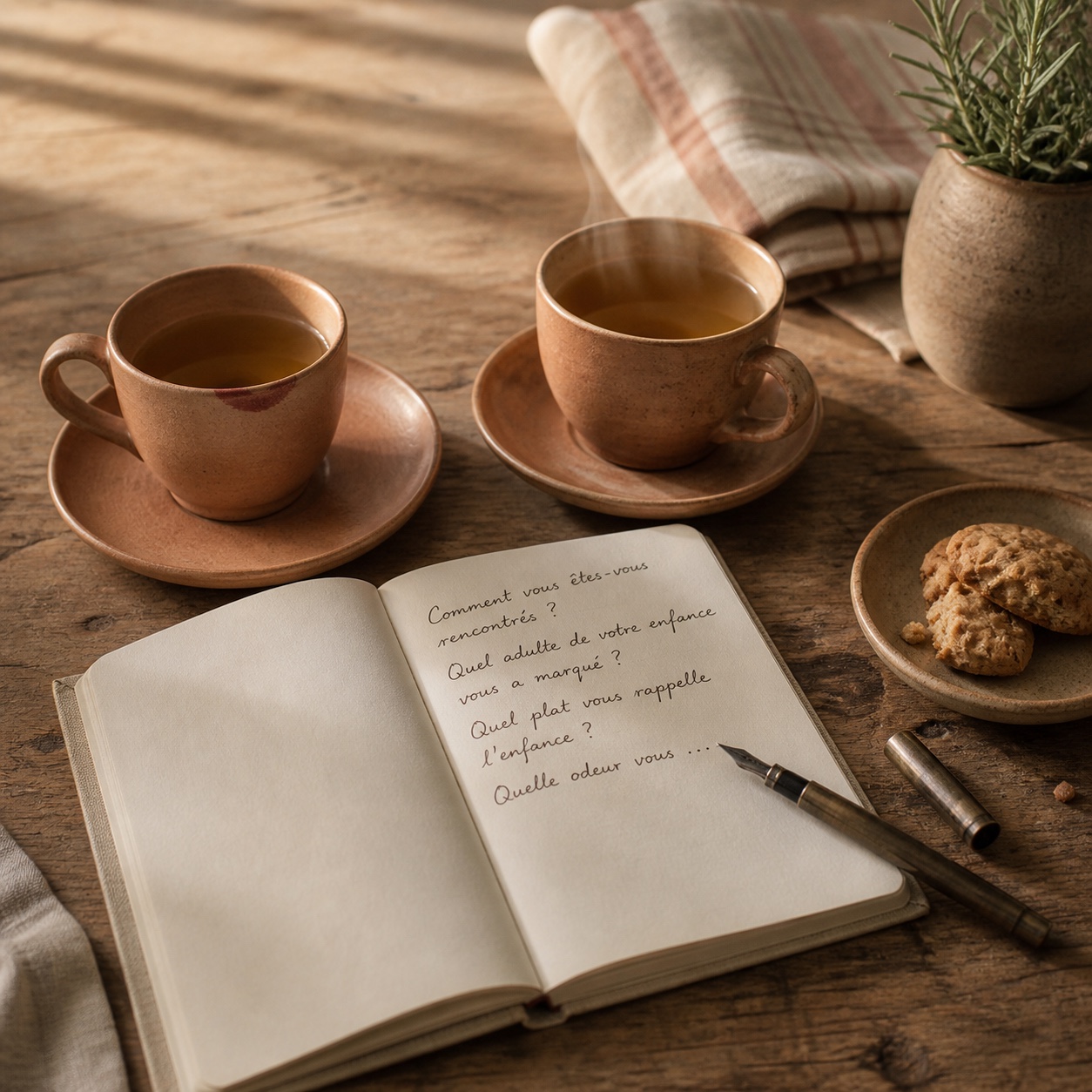
Here’s a grid of questions that helps capture the knack, on top of the basic recipe. You can ask them one by one, or slip a few in as the cooking goes.
- Who taught you this recipe? (The story often gives the key: “my mother always did… but my mother-in-law put in…”.)
- For what occasion do you make it? (A Sunday? a big meal? coming home from school?)
- Which moment in the recipe can spoil it all? (There’s always one. That’s where the know-how concentrates.)
- Which mistake have you made and don’t make any more?
- How do you know it’s done? (Colour, sound, smell, gesture with the spoon?)
- What do you change depending on what’s in the kitchen?
- Is there an ingredient that absolutely shouldn’t be replaced?
Note the answers literally. “I know it’s ready when it smells of hazelnut” is more useful than “cook for 8 minutes”.
How to organise it
Once you’ve written down a few recipes, give them a form.
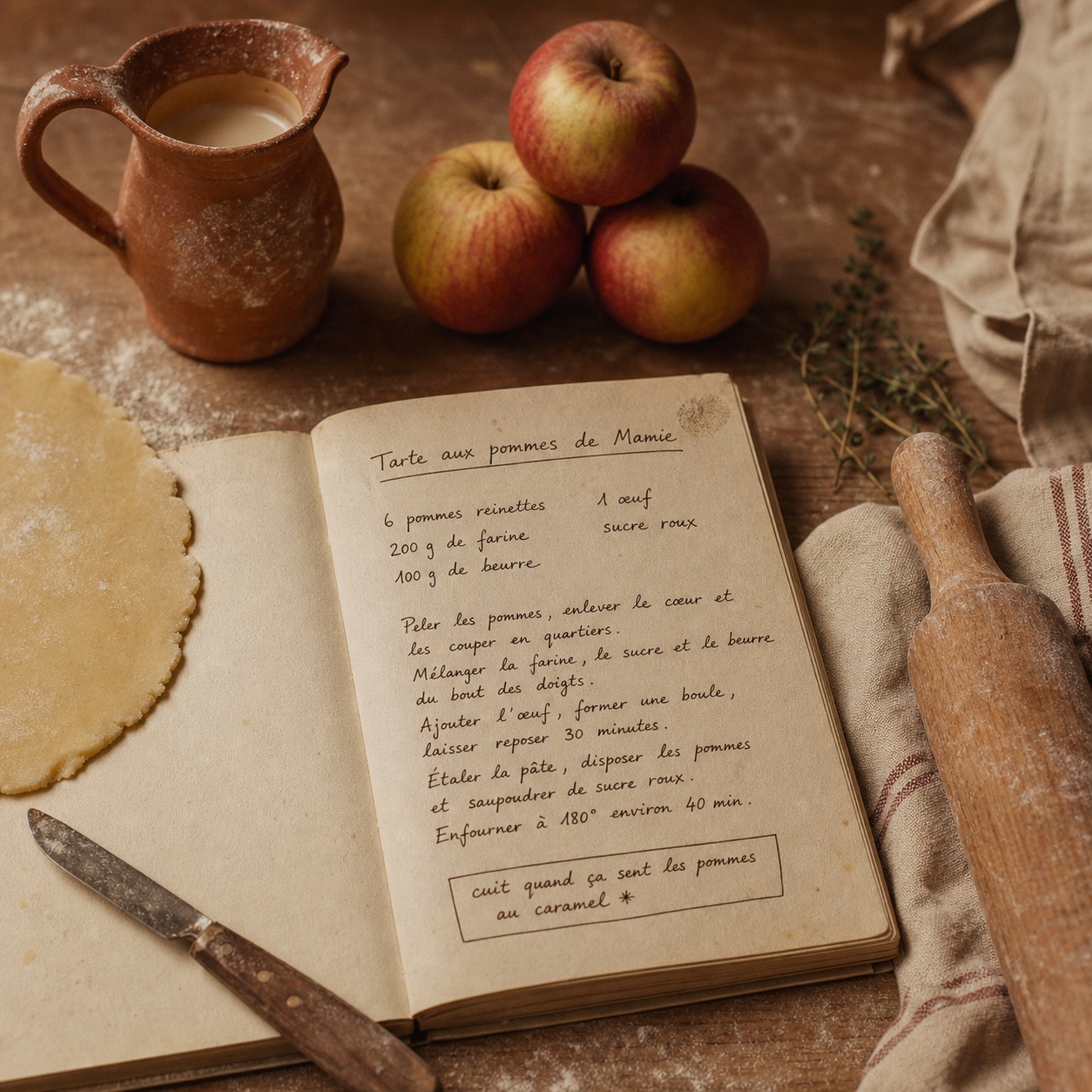
One sheet per recipe. Simple format, identical for all:
- The name (with, ideally, the author: “Granny Jeanne’s gratin”).
- The ingredients, in two columns if possible.
- The steps, one by one.
- A “knack” zone: that’s the one that changes everything. Three or four lines on what isn’t in the steps: the expected texture, sensory markers, what not to do.
- A “story” zone: who makes it, when, for whom, what gets told about it at the table.
A notebook or a digital file. The paper notebook is beautiful and works very well if few people use it. To share between siblings, cousins, nephews, a shared digital file (or a notebook like Carnely) is more practical. Many families do both: digital to gather, printed paper to give.
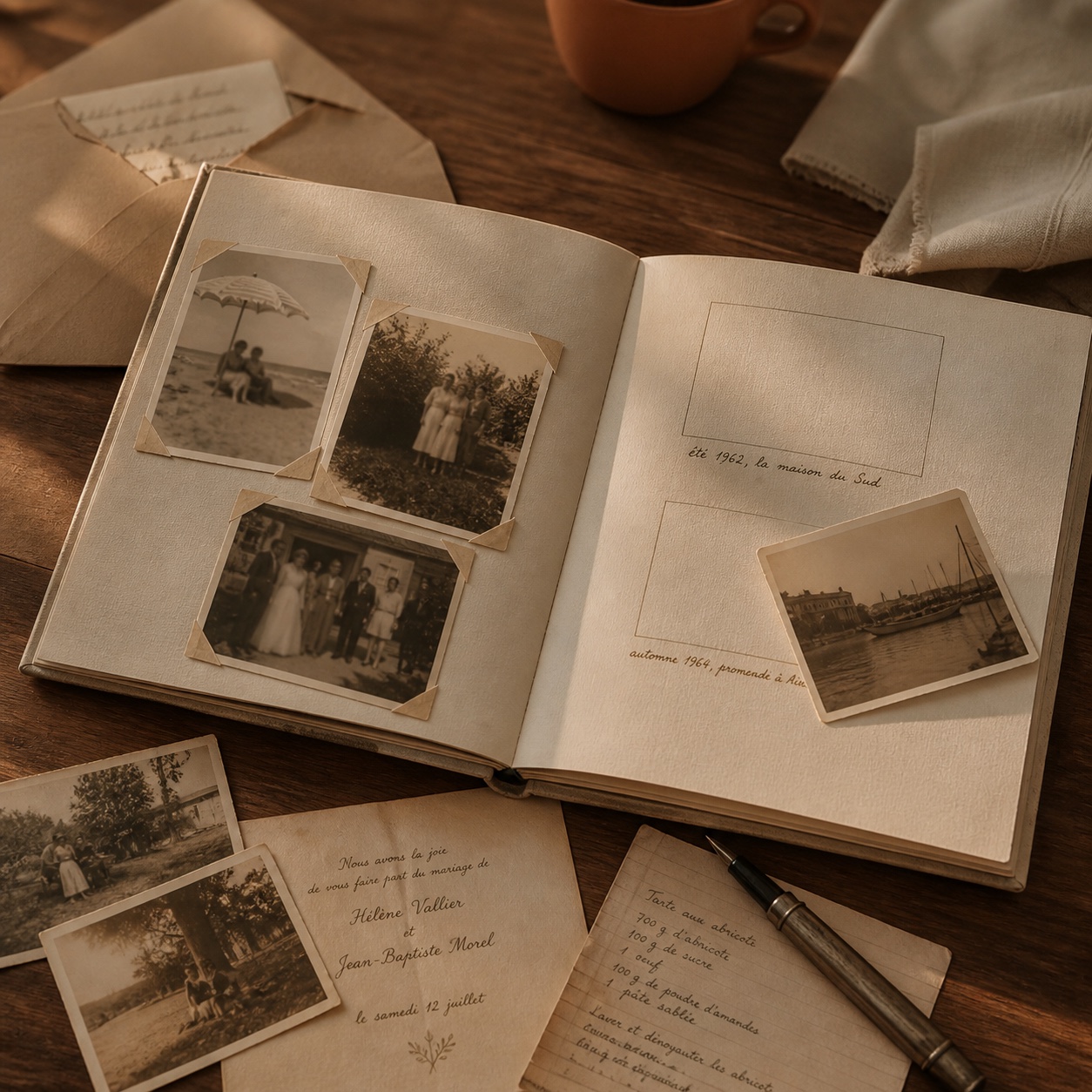
A photo of the handwritten recipe. If the recipe exists handwritten by someone (on the corner of a diary, on the back of a piece of cardboard), keep the photo of the original handwriting. It’s worth a whole page.
A place where they circulate
The risk with family recipes isn’t writing them poorly. It’s that they’re written somewhere, then forgotten. A file on a computer that gets replaced. A notebook stored away during a move. A sheet slipped into a book never opened again.
Three habits are worth it:
- Centralise. One single place where all recipes live. Not ten notebooks, not twenty files.
- Make a copy. Digital if you write by hand, paper if you write digitally. The duplicate protects from disaster.
- Let them circulate. A sheet asleep in a drawer feeds no one. Send it to the person who asked for it, bring it to the next shared meal, give the printed collection as a present. A recipe that circulates is a recipe that lives.
A notebook like Carnely serves this exact purpose: one place to set down each recipe with its photo and its story, and entrust it to the people in your circle, who read it today and cook it in turn. A few recipes chosen with care and well told are worth more than an exhaustive binder no one opens.
A recipe to begin with
If you want to test without waiting, pick one recipe tonight (the simplest, the most emblematic of your family) and call the person who makes it best. Ask them three questions:
How do you do it?
What can go wrong?
Who did you learn it from?
Note the answers as they come. You have your first sheet.
Going further
Recipes often open onto other family conversations. If you’d like to go further, here are thirty questions to ask your parents. And if you’re considering gathering these recipes into an object to give, this article describes the possible forms of a family memory book.
By

Carnely's journal is kept by Pierre Goux, co-founder of Carnely. Articles on choosing and sharing what matters with the people close to you.