Gather ·
How to get wedding photos from your guests
The day went by too fast, and the best of it is with the others: the photos you are in, the moments you never saw. Here is how to bring it all together, privately.
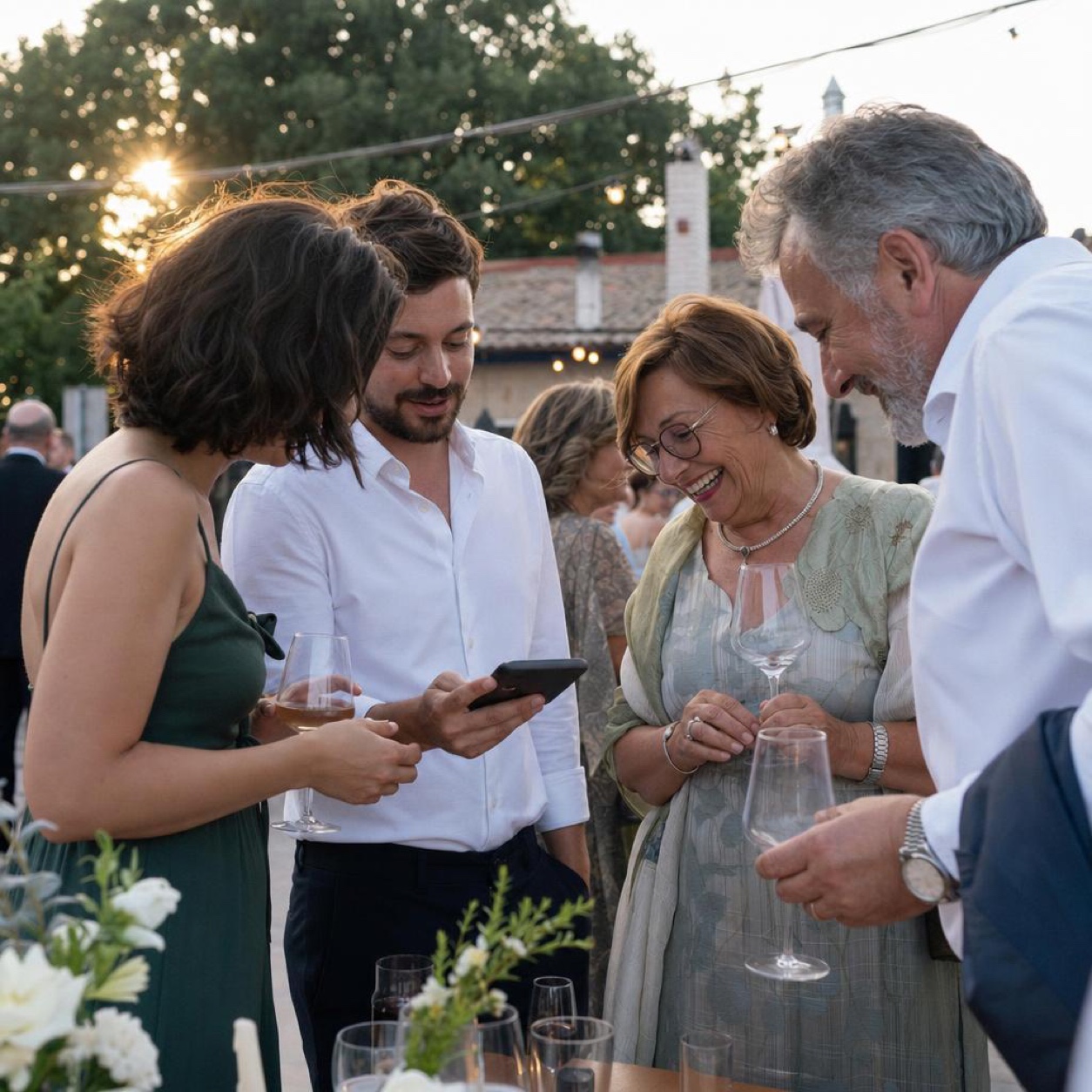
The wedding went by too fast. Everyone told you it would, you did not quite believe them, and here you are: the day you prepared for months already fits into a handful of rushing images. What people tell you less often is that the whole day still exists, in pieces, on your guests’ phones.
Every table saw a different wedding. The preparations on the side where you were not, the fit of laughter during the speech, the far table that invented its own game, the two of you from behind while everyone was watching. The photographer covered the essentials; your guests caught the rest, and often the pictures where you are most yourself.
What remains is to bring them together. This is where many couples lose the thread: they ask everyone for everything, and receive either nothing or eight hundred photos in bulk. Here is how to do it differently.
What your guests saw, and you did not
The photographer follows the couple: that is the job, and it is done well. But a wedding happens in thirty places at once. While you were listening to the speech, someone was photographing your grandfather wiping away a tear. During the first dance, a friend was filming the children’s table, dancing too, in its own way.
These images have a particular value: they are the only ones where you appear without knowing you were being watched. The official coverage shows you looking your best; your guests’ photos show you happy. Both matter, but the second kind cannot be replaced, and it sinks fast: within a month, those pictures are buried under the photos of everyday life.
The QR code on the table: many photos, few memories
Photo collection services with a QR code on each table promise everything: every guest scans, everything lands in a shared gallery. It works, in the strictest sense. You receive eight hundred photos.
Then you open the gallery. Burst shots of the ceremony, fifteen versions of the same cake, blurry frames from the dance floor at midnight, and no order, no names, no context. Who took this one? What was making that whole table laugh? The gallery does not say. Automatic collection gathers everything and tells nothing: what you are left with is evenings of sorting, and the will fades with every screen.
The shared folder and the group chat: two reflexes that fall flat
The shared online folder sounds reasonable: one link, everyone uploads. In practice, participation stays low. Putting photos into a folder is effort without any return: nobody sees what you added, nobody says a word about it. Three guests comply in the first week, then the link goes quiet among the archived messages.
The group chat, at least, already exists. But messaging apps compress images, wedding photos blend into the next day’s messages, and the thread scrolls on: what was posted in July cannot be found in September. The chat keeps the conversation, not the day.
Ask for less, receive more
All three methods fail for the same reason: they ask for everything, and everything has no value. Eight hundred photos do not make a memory. They make a folder.
The request that changes the outcome fits in one sentence: “Send us your best ones, not all of them.” Each of your guests knows exactly which of their photos are worth something: the one where the light fell just right, the one of the laughing fit, the one nobody else has. By asking for a choice, you receive fewer images and more of the day. And if each person adds a sentence, where it was, what was happening, what went through them at that moment, the photos become a story.
You then need a place that receives this choice without drowning it. That is what a Carnely chapter offers: you open a chapter for the wedding, you send one link, and each guest enters in thirty seconds, puts down their best photos and tells them in a few words. It is free for them, private, ad-free, and nothing scrolls away: a year later, the day is still there, told by the people who lived it.
When to ask, and how
The right window is short: the days just after the wedding, while everyone is still reliving the day and already sending pictures around. One message within the week is enough:
“We are barely landing, and we would love to keep the day the way you saw it. Send us your best photos, not everything: the ones you would keep, with a word if you like. Here is the link.”
One single reminder, about ten days later, brings in the stragglers. Beyond that, those who have not answered will not answer, and that is fine. For the tables you know less well, go through the witnesses: a request carried by someone close works better than a general message.
One year later
A year after the wedding, nobody reopens a folder of eight hundred files. But a chapter where forty people each put down their three best photos and two sentences? That gets opened. In it you find the wedding you did not see: the preparations on the other side, the far table, your parents when you were not looking.
That is the difference between collecting and gathering. Collecting makes a pile. Gathering composes, together, the story of a day that went by too fast for a single pair of eyes.
By

Carnely's journal is kept by Pierre Goux, co-founder of Carnely. Articles on choosing and sharing what matters with the people close to you.