Share ·
What is a memory, really?
Memory is not a camera, and a photo library is not a memory. A memory is chosen, rebuilt and retold: that is precisely how you recognise one.
Open your phone’s photo library: ten thousand, twenty thousand images, sometimes more. Now close your eyes and look for what remains of last summer. Twenty thousand things do not come back. Three or four do: a dive, a conversation that ran late, the smell of warm pine on a car park. Those are the memories. The rest are files.
The two get confused more and more, and the confusion is not harmless: it changes how we live our moments, then how we keep them. So the question is worth asking plainly: what is a memory? What research says about it is more surprising, and more useful, than you might expect.
A memory is not a recording
Common intuition pictures memory as a camera: moments get recorded, filed away somewhere in the brain, and replayed identically when recalled. Research has been saying otherwise for almost a century. As early as the 1930s, the psychologist Frederic Bartlett showed that remembering is not replaying a tape: it is rebuilding a scene from fragments, every time you summon it.
Each recall is a fresh construction. You do not retrieve the meal you had at ten years old: you remake it, from the sensations you still hold, what you have been told about it since, and who you have become in the meantime. The work of Elizabeth Loftus has shown this to an uncomfortable degree: details move, appear, rewrite themselves, and nothing signals it.
That is not a manufacturing fault; it is the nature of the thing. A memory is alive: it evolves with you. And that is exactly what sets it apart from a file, which never moves and means nothing on its own.
A photo is not a memory
If memory does not record, then a photo cannot be the memory. It is the trigger: a cue that helps the rebuilding start. The distinction sounds subtle; it changes everything.
In 2013, the psychologist Linda Henkel had students tour a museum: those who photographed the works remembered them less well than those who simply looked. Her study gave that reflex a name: delegating the moment to the device. The photo is taken, so you excuse yourself from being there. The device keeps the image; no one keeps the memory.
The other half of the problem shows up later, in the library. An image without context goes mute: you have surely already stumbled on a photo from your own phone without being able to say where, when, or why it exists. Twenty thousand images do not make twenty thousand memories. They make a reserve of triggers, most of which will never trigger anything.
Why some moments stay
Three ingredients run through everything we know about memory: attention, emotion, singularity. You retain what you actually lived, present and with your eyes open. You retain what did something to you, joy as much as stage fright. And you retain what stood out from the ordinary, because the repeated gets compressed: two hundred commutes to the same office become one generic commute, with no date.
That is good news in disguise. Memory naturally does the sorting your photo library never does: it does not keep the flow, it keeps the moments. The grain of a memory is neither the day nor the year. It is the scene: a place, people, something happening, and a reason to remember it.
A memory is a story
Look at the shape your memories take when you share them: they are stories. “The time the car broke down on the way back from the wedding.” A beginning, characters, a punchline. We do not remember in pixels, we remember in narratives, and every telling fixes the version a little more.
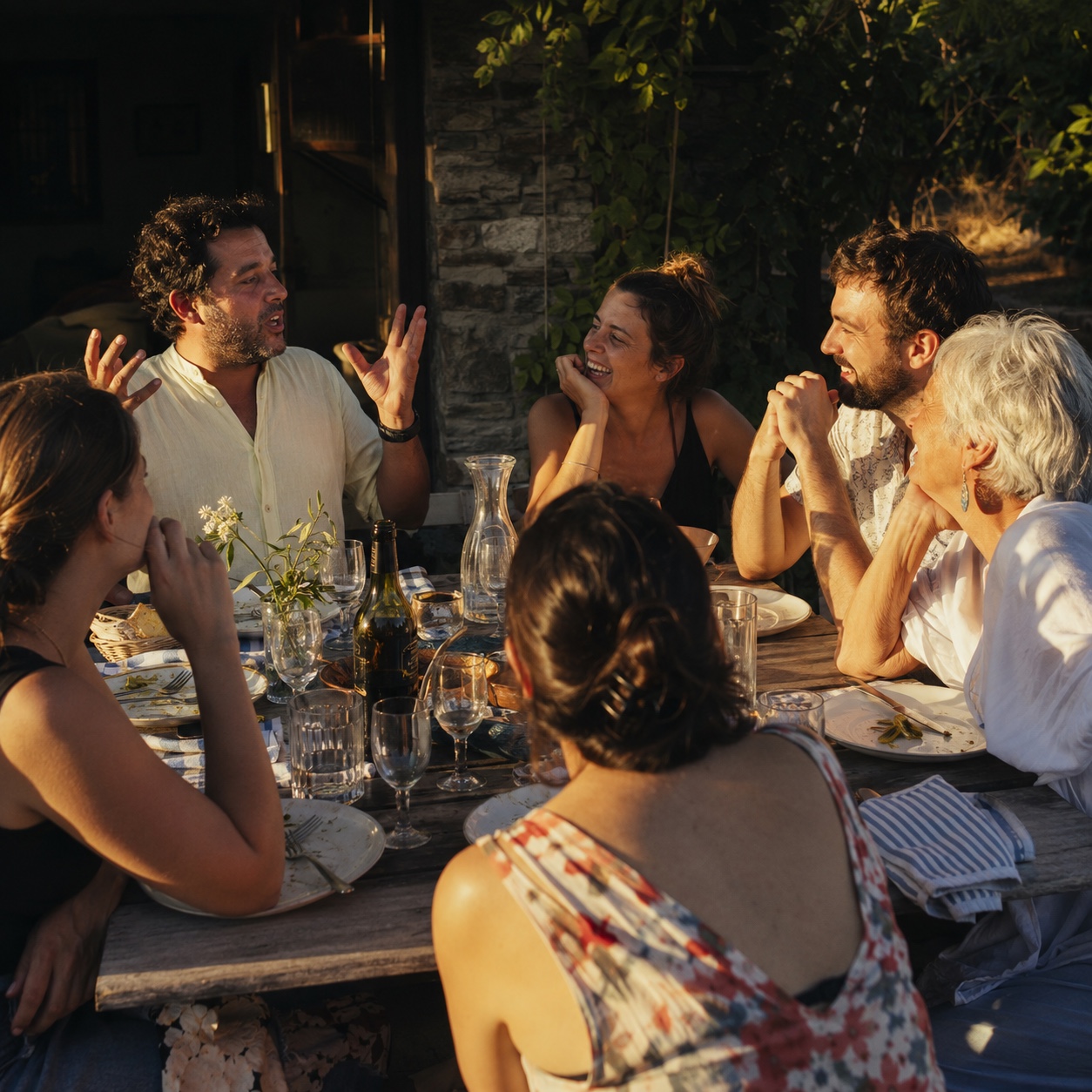
That is why shared memories hold better than memories kept alone. In a family, in a circle of friends, the moments that survive are the ones people tell each other: each person holds a fragment, corrects it, adds the detail the others had lost. A memory told in several voices is sturdier, and often truer, than one person’s recollection.
It also clarifies what an image needs around it to remain a memory: not metadata, a story. Where you were, who was there, what happened, why that moment. A few sentences are enough to keep a photo tellable in ten years, including by someone who was not there.
Choosing is already remembering
If a memory is a moment rebuilt and retold, then keeping your memories cannot mean storing everything. Storage preserves files; it produces no memories. What produces them is the opposite gesture: returning to a moment, choosing the two or three images that carry it, and saying why those.
Everyone does that gesture their own way. Some keep a notebook, some print and caption their photos, others do it in a digital place made for it, like Carnely, where a memory is exactly that: a story and a few chosen media, entrusted to a precise circle rather than published. The form matters less than the gesture. Choosing and telling is doing memory’s own work yourself, and doing it better.
What you still tell
A memory, in the end, is not what your phone keeps: it is what you still tell. The test is simple and it does not lie. What you have never told anyone, never reread, never called up again, barely exists any more. What you tell lives, sharpens, travels.
The experiment takes five minutes. Take a moment from last month that did something to you. Find the one photo that carries it, just one. Then write three sentences: where it was, who was there, what makes that moment stay. You have just made a memory in the full sense: chosen, rebuilt, tellable. That is exactly what the photo library, on its own, will never do.
By

Carnely's journal is kept by Pierre Goux, co-founder of Carnely. Articles on choosing and sharing what matters with the people close to you.