Share ·
Writing the story behind a family photo: three lines are enough
You have eight thousand photos on your phone, and not one of them says what you actually see in it. Here is a tiny habit that keeps the photo telling who, where and why, even thirty years from now.
You have eight thousand photos on your phone. You open them now and then, you scroll, you smile at two or three, you close. None of them carries a caption. None of them has a line saying who, where, why.
Thirty years from now, your children will open that same roll, or what is left of it, and they will not know. Not who the woman beside you is, in the photo from July 2024. Not why you are laughing so hard. Not what that day meant. The photo will be there, untouched, and silent.
That is the trap of modern devices. They keep everything and say nothing. For a photo to remain a memory, it needs three lines written next to it the same evening. Not a book. Not a full page. Three lines.
Why the photo alone is not enough
Twenty years on, a photo on its own raises more questions than it answers. Who is the man in the blue shirt on the left? Where exactly is this? Why a table set outside, on a Tuesday? At the moment you took it, you knew. It was obvious. It is precisely that obviousness which does not get written down, and which fades first.
Visual memory holds longer than contextual memory. You will recognise your cousin’s face twenty years later, but you will no longer know whether the photo was Christmas or Easter, nor who was missing that day. And that missing detail is often what makes the photo precious.
Without three lines, the photo becomes an image. With three lines, it becomes a moment again.
What fades first
Three things go before anything else, and all three are unrecoverable.
The names of the secondary people. Not your brother or your mother, who stay obvious. But the elderly uncle in the second row, the family friend passing through, the baby of a cousin you have not seen since. Their first names vanish within ten years.
The exact date. You will remember the year, sometimes the season. You will no longer know the day, the morning that came before, the sequence of the week. The phone’s timestamp gives you a raw date, not a moment.
The why. Why this day was photographed and not another. That is what separates a memory from an image. The photo tells you what; the three lines tell you why.
These three losses are invisible as long as you are around to fill in the blanks. They become vertiginous for the generation that inherits.
The three lines: who, where, why
The rule is simple, and it fits into a five-minute habit.
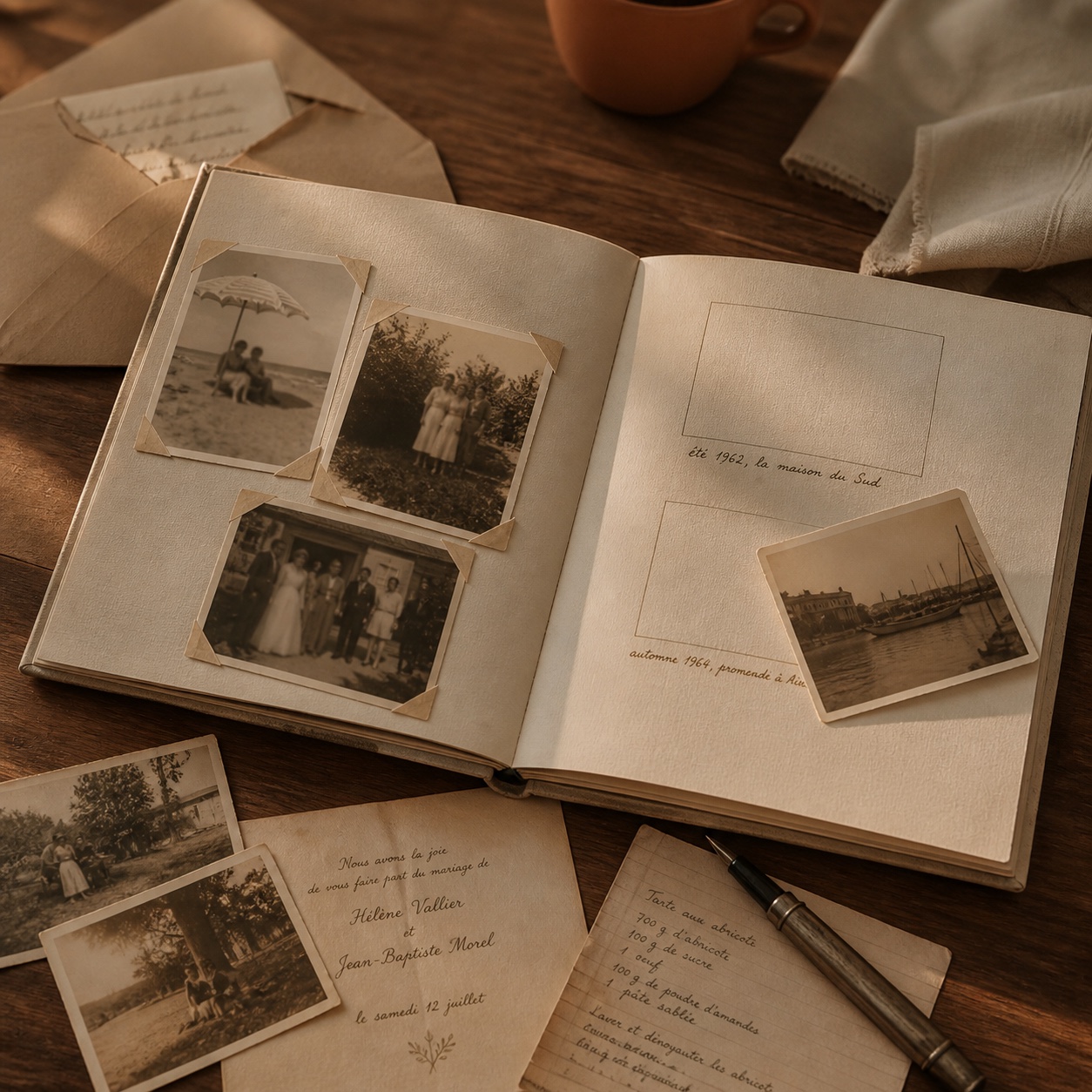
Line one, the who. Name every visible person, in the order in which you see them. Front row: my father, my sister Camille, her daughter Léa (four). Behind: the Marchands, our neighbours since 1998. No effort to make a sentence, just names.
Line two, the where and when. The exact place, and the full date if you have it. Garden of the Quimper house, Sunday 14 July 2024, around 5 p.m. If the place deserves a detail, add it. Under the lime tree, just before the storm.
Line three, the why. One sentence, only one, on what the photo meant to you when you took it. We had just learned my sister was moving to Canada in the autumn, and this was likely the last Sunday all together for a while.
That third line is what turns the photo into a memory. It is also the easiest to write on the day itself, and the most impossible to recover later.
The right moment: the same evening
The secret is the window of time. Three lines written that evening take two minutes. The same three lines written six months later take twenty minutes and feel like a guessing game. A year later, you will not write them at all.
Place the photo somewhere, open a notebook or an app, and write before going to sleep. If writing every evening feels heavy, do it only for the photos that matter. Not the eight hundred shots from the weekend, but the two that deserve to stay. The sorting happens naturally.
A simple rule for choosing: if in ten years you want to find this one again, it deserves three lines. Otherwise, leave it in the roll.
The old photos you inherit
The opposite problem appears when you receive a box of photos after someone has died, found in a loft. Nothing is written on the back. No one will tell you any more who the young woman in the polka-dot dress is.
The method changes here. Do what you can: gather the family on a Sunday, spread the photos on the table, and write down what each person recognises. An eighty-year-old aunt names a face that no one else names. A cousin remembers the dress because she wore it as a child.
Write everything down, including the guesses. Probably Lyon, in the sixties, perhaps a great-uncle’s funeral? Written uncertainty is worth more than lost certainty. What is written stays. What is said aloud goes with the person who said it.
The photo becomes a memory
Slowly, photo after photo, what was once a roll of images becomes an album. Not a bound book, but something more lasting: a sequence of moments whose substance you know. When you come back to one of these pages in fifteen years, you will recover what you thought you had forgotten, because you wrote it down that same evening.
For those who want to keep these pages in a single place, accessible to the people who matter, a setting like Carnely lets you attach three lines to each photo, by chapter or by date, and make them readable to the people you choose. The idea is not new. It is what the great photo albums of the past did, with ink and glue. The practice was lost with the digital roll. It is easy to take up again.
One photo, tonight
Before you close this article, open your phone. Pick one photo from the last seven days. Write its three lines now, anywhere you like, in a notes app, on the corner of a notebook, in a draft email.
It is the most modest of habits, and also the one that changes everything. Thirty years from now, that is the photo your grandchildren will understand. Not the seven thousand nine hundred and ninety-nine others.
By

Carnely's journal is kept by Pierre Goux, co-founder of Carnely. Articles on choosing and sharing what matters with the people close to you.