Keep ·
Passing down a family garden: writing the gestures so they hold
A family garden is not passed on through tools alone. It holds a calendar, learned gestures, chosen varieties. Here is how to set all that down on paper, so it goes on.
There is a patch of ground you know by heart. The vegetable plot behind your parents’ house, your grandmother’s little town garden, the orchard nobody ever truly counted. You helped there as a child. You came back to it as an adult. You know where the weeds always return, and where the raspberries are sweetest.
And then one spring, it is no longer the same hand doing the pruning. Somebody else waters, weeds, plants. Often that somebody is you, and you discover that many of the gestures you thought you had learned came to you through watching, not through words. You no longer know exactly when your father pruned the roses, or why the tomato plant always went back in the same spot.
A garden is passed on through the hand, yes. But when the hand is no longer there, what is missed most is what nobody ever took the time to write down. This article offers a few angles for doing that, without ceremony.
What really gets passed on in a family garden
When you ask someone to talk about the garden of their parents, they rarely start with a list of plants. They start with the sound of the gate, the smell of wet soil in spring, the bench where you sat to catch your breath between two rows.
What makes a garden this garden and not another is not a catalogue. It is the whole set of quiet decisions made over forty years.
That includes:
- The calendar. When your mother began the seedlings. At which moon your grandfather took cuttings from the carnations. Which late frost lost the apricots in 1996 and shifted everyone’s caution for good.
- The varieties. The tomato you keep because it came from Uncle Henry’s seed jar. The apple tree whose name nobody knows anymore, but which everyone agrees ripens in September.
- The learned gestures. The pruning of a rose bush you do not learn from a book. The way of tying the vine. The glance that tells you to pick today and not tomorrow.
- The forbidden corners. The square that nobody touches, because the irises have come back there for thirty years. The border nobody dared to redo after your father.
- The things given up. What was tried and abandoned. Why the potatoes are no longer planted since the back gave way. Why the far end was let to run wild.
That is what fades first. Seeds, you can find again. The map of the garden as it once was, never.
Where to start writing it
Rather than building a catalogue, pick an angle. Four work well.
1. One particular corner. Not the garden in general. The patch of herbs near the door. The currant hedge along the wall. The wisteria that grew up alongside your children. Describe what is there, who planted it, who tends it, what should stay, what can move. One page per corner is enough.
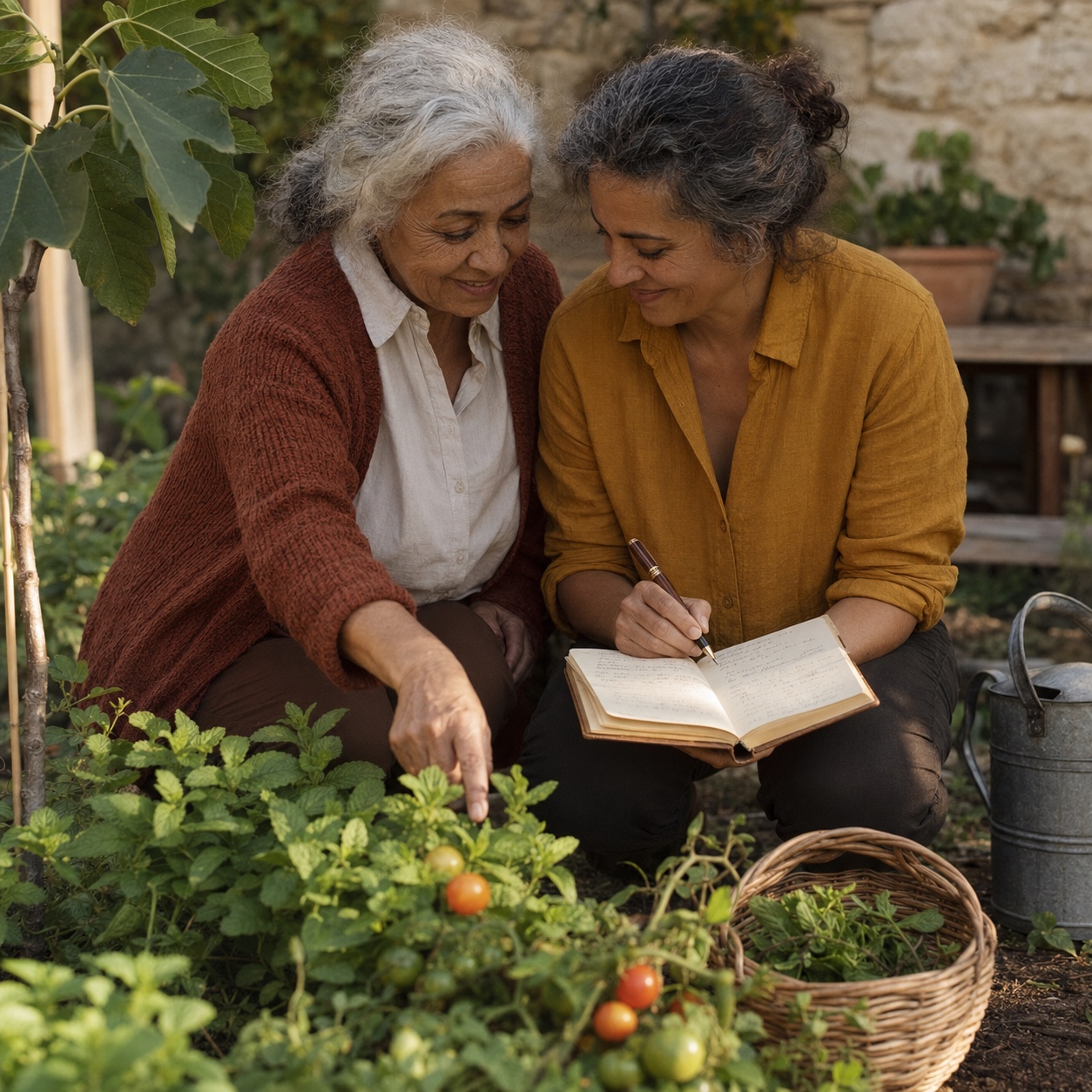
2. A gesture you were shown. Pruning the roses in March. Pinching out the tomatoes. Covering the hydrangeas before winter. Pick a gesture you hold from one person only. Tell who showed it to you, at what age, in what phrase. Set the gesture itself down as you would explain it to someone who has never held secateurs. You pass on a technique and a voice at the same time.
3. The year’s calendar. Month by month, what is done in this garden. Not a generic horticultural sheet: yours. You know that in your corner, by late February the cover comes off the fig tree. That in early June, the vole returns to the bulbs. That by mid-October, the rain falls enough for you to stop watering. That calendar exists nowhere else. One page is enough to set it down.
4. A plant, and its story. A tree, a shrub, a cutting that has held on for decades. The old rose your mother-in-law brought from her own place. The fig tree that survives though everyone said it would not. The mint you brought back from a garden that has since disappeared. Tell where it comes from, who planted it, what is expected of it, what is forgiven of it. A plant can hold for a hundred years, its story fits in thirty lines.
When the garden changes hands
At some point, the original garden is no longer yours. Your parents have sold, the country house has gone, or you yourself have moved into something smaller. Part of the garden stays where it is, under other hands. Another part, sometimes, you take with you: a cutting, a young plant, a few seeds in an envelope.
A garden is rarely passed on whole. It is passed on in pieces, through moves, through adoptions. And that is exactly when the writing helps.
Before the land changes hands, or shortly after, take the time to write down what matters. Not everything. The essentials: what must be protected, what can be moved, what is not meant to last. If you offer a cutting, slip a page in with it. This wisteria comes from my mother’s garden, planted in 1972, pruned in February. It needs open ground and a south-facing wall. That page is worth more than a printed label.
It is also the moment to write to whoever takes over the land, even if you do not know them. A short letter left in the house, or filed with the notary. Not an instruction. A handing-on: what this garden has been, what you hope will remain, what you leave it free to become.
A notebook held by several voices
A garden has almost never been the work of one person. There is the one who planted the tree forty years ago, the one who saved it from being cut down, the one who comes to water when you are away in July. The garden’s notebook is also better when held by several.
Ask your spouse, your brothers and sisters, your adult children, your mother or father if they are still around, to add what they remember. You will be surprised. What you call the far end of the vegetable plot, your sister calls Granny’s square. The apple tree whose age you no longer know, your cousin planted it with your grandfather in 1981. The hedge you now find ugly, your daughter used to hide in it to sulk.
The versions do not cancel each other out. They complement each other. And that is what keeps the notebook alive, rather than a stocktaking sheet.
Whether it is a notebook left in the summer kitchen, a file shared between you, or a place made for this kind of thing like Carnely, the right format is the one each person can open after a day in the garden and add to at their own pace. A photo taken on a phone, three lines. That is already material.
One thing to set down this weekend
If you close this article and want to begin today, take ten minutes after coffee and write the answer to one question:
In your garden (or in your parents’), which corner have you never touched and would like to see continue? Where does it come from, and who made it?
A few lines are enough. You have just written a page that, in twenty years, will exist nowhere else.
Going further
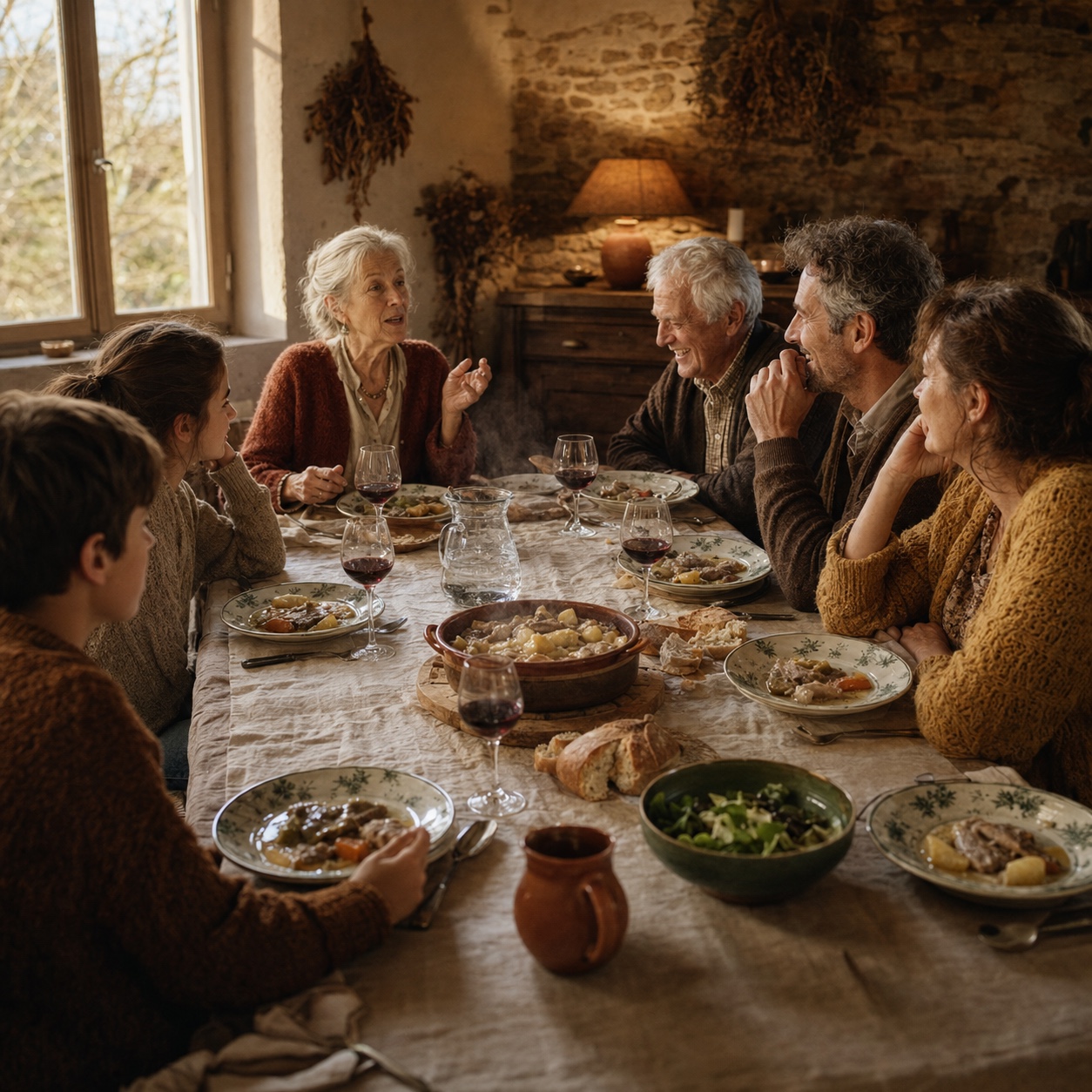
A garden is often passed on alongside other rituals of the same register: the Sunday family meal is the most obvious, because it often ends with the vegetables from the garden and the walk that follows. And if you feel you want to gather what comes through the senses (the smell of soil, the cicadas, the late August light), the article on sensory memories will give you a path.
By
Carnely EditorialCarnely's journal is written by a small editorial team based in France. We write about sharing what matters with the people close to you, starting today, at your own pace.