Keep ·
Sunday family meal: writing it down so it keeps being played
The Sunday family meal carries more than a menu. It holds a voice, an order, rituals that nobody ever writes down. Here is how to set them down, while they are being played, and share them.
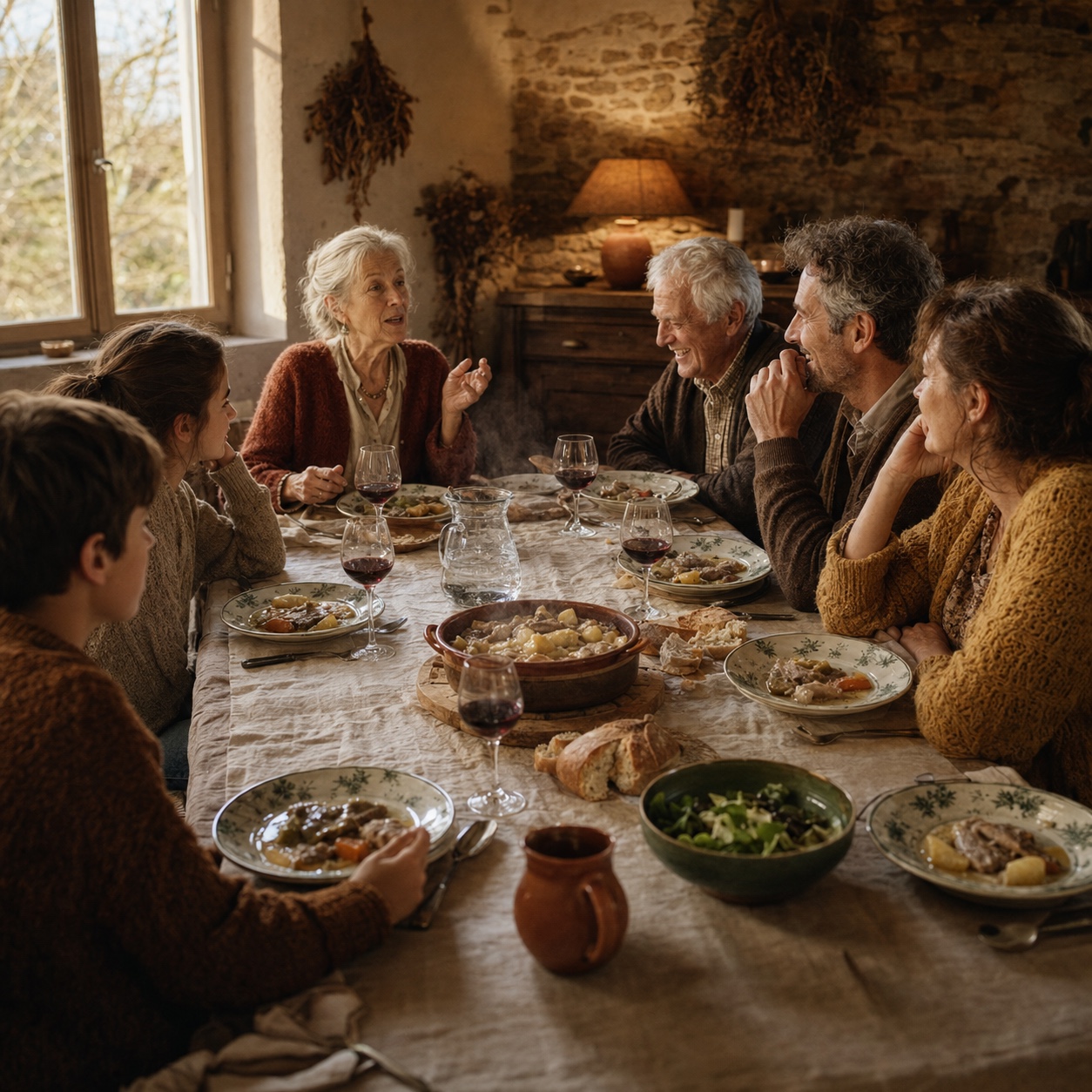
There is a ritual many families share without talking about it much. The Sunday meal. The table a little larger than on other days. The dish that has been simmering since morning. The hours stretching all the way to coffee, sometimes beyond.
This ritual does not belong to the past. It is being played this very Sunday, at a parent’s house, at a grandparent’s, in a flat where a group of friends has set up its own weekly lunch. And it travels: it changes city, table, cook. Whoever sits at that table long enough often ends up hosting it in turn.
What travels less well is everything that organises it. A Sunday meal carries a cuisine, certain phrases, an order of courses, a way of breaking the bread, accepted silences. None of that moves from one table to the next on its own. It moves the day someone writes it down, and gives it to the people who were at the table to read.
This article offers a few angles for doing that, without trying to tell everything at once, and without ceremony. A few scenes, chosen with care, are enough.
What makes a Sunday family meal
When you ask someone to tell you about their family’s Sunday meal, they rarely start with the menu. They start with something else. The colour of the tablecloth. Their grandfather’s seat at the head of the table. The phrase their mother says before the first spoonful. The smell of the dish coming out of the oven exactly at noon because everybody knows that is the time.
The menu itself is almost interchangeable. What makes a Sunday meal this one and not another is the whole set of unspoken things that organise it.
That includes:
- The order of courses. Aperitif in the living room or straight to the table? Soup first, or not? Cheese before or after dessert? Coffee at the table or back in the living room? Each family has its protocol, and nobody writes it down.
- Each person’s seat. Who sits where? Who gets up to serve? Who clears the table? It seems obvious until the Sunday you receive guests for the first time, or the day you host the meal at your own place.
- The ritual phrases. The blessing or the bon appétit, the thank you for the meal, the joke that has been told every Sunday for twenty years. The phrases that are only funny at this table, and that make a family.
- The specific gestures. The way your father carves the roast. The pitcher you always fill the same way. The slice of cake set aside for whoever comes in late.
- The silences. The moment when people stop talking because they are eating. The silence after coffee, before someone suggests a walk.
That is the grammar you cannot see while you are sitting at the table. The recipes can always be found again. The grammar only exists in writing if someone sets it down.
Where to start writing it
Rather than trying to set everything down at once, pick an angle. Four work well.
1. A particular Sunday. Not the Sunday meal in general. One precise Sunday. Last weekend’s, or one you remember. The one when your daughter came with someone for the first time. The one when your grandmother announced she was handing over the Christmas cake. The one before a big move, the last in that particular house. A scene can be told in two pages. The rest will come.
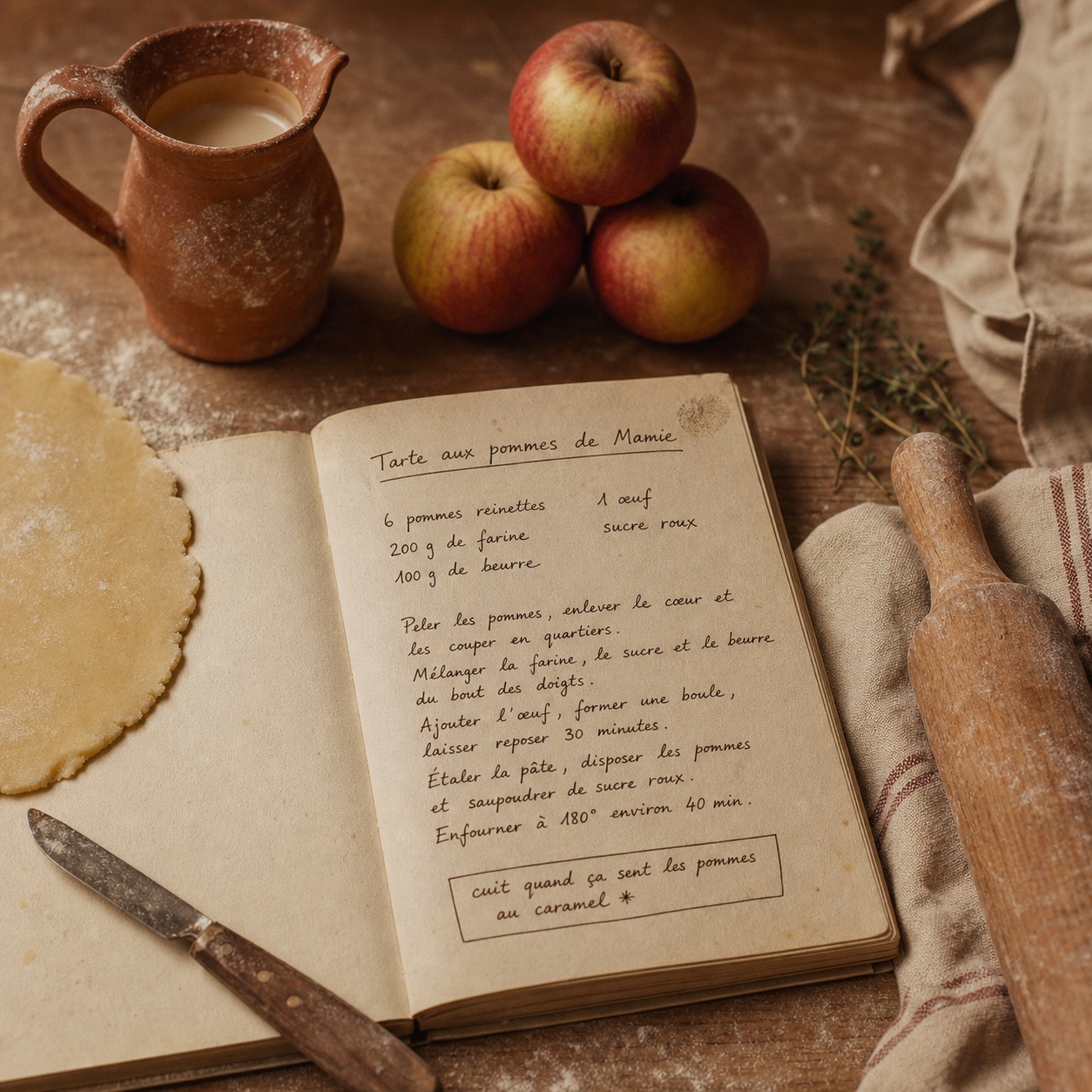
2. The signature dish. Every family has one. Your mother’s pot-au-feu, your mother-in-law’s blanquette, your grandfather’s apple pie. Describe not the technical recipe but the context: who learned it from whom, on what occasions it comes out, what it means for the one who makes it. The technical recipe, you can write down in parallel: that is a separate, complementary exercise.
3. The table itself. Describe the table like an object. The tablecloth (which one, bought where, taken out how?). The cutlery (silver, mismatched, counted?). The big tureen at the centre. The water jug, the wine pitcher. The Sunday bouquet. It is a short text but a dense one, and it fixes the visual memory. If you get stuck, start with the sensory memories first: smells, sounds, light.
4. A phrase that comes back. Don’t talk with your mouth full. Leave room for dessert. You can have seconds in a minute. Pick a phrase from your family. Tell where it came from, who says it, what it really means, who it speaks to today. A phrase fits in fifty words and carries fifty years.
How the ritual gets replayed from one table to the next
The Sunday meal never stays at the same table for long. The children settle in another city, someone receives guests for the first time, one generation invites the previous one over. The ritual does not pass itself on by decree. It gets replayed, through successive shifts.
Many families know a season when the Sunday meal becomes rare. Then someone, often in the middle generation, reopens it. Not every Sunday. Once a month. At their place. With the pieces that can be carried over (the signature dish, the tablecloth, the time) and everything that changes shape along the way.
This crossing is exactly when the writing helps. Not to freeze what is being played. To let whoever takes over the table know what the ritual carries. What you would like to keep. What does not have to be reproduced. What is allowed to change.
A single page is enough. The Sunday meal, at our house, is this. Here is what matters, and here is what you can move. That page is worth more than a cookbook.
A notebook held by several hands
The Sunday meal was never the work of one person. Someone cooks, someone sets the table, someone talks to fill the silences. The notebook, in the same way, is better when held by several hands.
Ask your spouse, your brother, your adult children, your mother, to add what they remember. You will see that no one has kept the same scene. What for you is your father’s phrase is, for your brother, the cigarette break before dessert. What for you is the tablecloth is, for your daughter, the seat she always sits in.
The versions do not cancel each other out. They complement each other. And it is that weave that keeps the notebook alive, rather than a frozen photograph.
Whether it is a paper notebook passed around, a shared file, or a place made for this kind of thing like Carnely, the right format is the one each person can open and add to, without having to ask permission. If you do not know where to begin gathering, ask a simple question of each person, privately. What do you keep, yourself, of the Sunday meal at your grandparents’ house? The answer, written or recorded, is already material.
One thing to set down this Sunday
If you close this article and want to begin today, take two minutes after coffee and write the answer to one question:
What is the exact order of courses, and where does each person sit, at your parents’ or grandparents’ table?
A few lines are enough. You have just written a page that exists nowhere else, and that the people who were at the table can read with a smile this very evening.
Going further
If you also want to gather the family recipes that circulate around that table, that is a related exercise you can take on in parallel. And if you feel that the Sunday meal is only a fragment of all you would like to tell, this article on writing a family biography shows how to go from the fragment to a whole that holds.
By

Carnely's journal is kept by Pierre Goux, co-founder of Carnely. Articles on choosing and sharing what matters with the people close to you.