Share ·
Sharing memories with family abroad
When family lives in several countries, shared memories hold more value than news. Here is how to put them down so the distance doesn't swallow them.
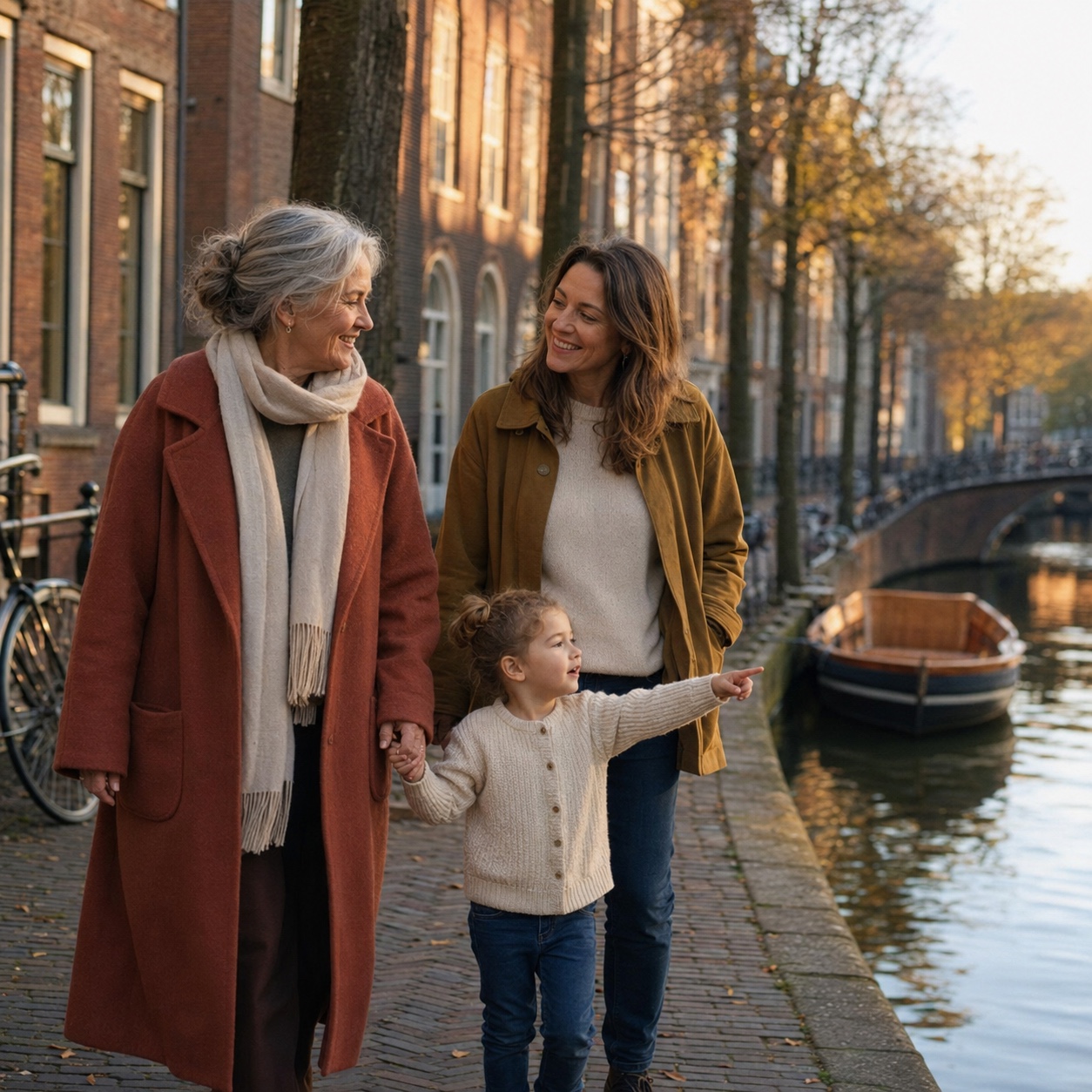
Your children left the country at twenty-five, and never came back. Your grandchildren were born in Toronto, in Berlin, in Sydney. You see them two weeks a year, in the summer. The rest of the time it’s WhatsApp, sometimes a Sunday video call, photos that scroll past without ever really being talked about.
It holds, more or less. But something is being lost. Not the affection, which stays strong. Rather the fabric, the thickness, what used to be called family memory and that built itself without anyone thinking about it, back when you saw each other every week.
This article suggests a way to give substance back to what passes between you, without asking for more presence than geography allows. The idea isn’t to write more. It’s to write differently: fewer news, more memories.
News fades, memories settle
What flows between a scattered family is almost always information. The weather, school, the calendar, a photograph of a meal. It’s useful, it reassures, it keeps a contact. But it doesn’t stay. No one rereads a WhatsApp message from last October.
A memory, though, settles. A scene told, a precise detail, an anecdote that steps out of the calendar and into memory, that is what gets reread ten years later, quoted at the table, passed on without anyone planning it. Distance doesn’t dissolve family; it simply changes what needs to circulate. When you are neighbours, you talk about tomorrow. When you live in two countries, you also need to talk about before.
That is the first choice to make, and it changes everything. What you tell your daughter in Berlin doesn’t have to be the account of your week. It can be the account of a Sunday forty years ago that you’ve just remembered.
A precise memory rather than a summary
When you sit down to write to someone you haven’t seen in three months, the temptation is to summarise. All is well, the garden did beautifully, my sister came round last week. It’s lukewarm, it’s short, it doesn’t print.
Prefer a single scene, told in five lines. The rose bush you pruned on Thursday, because the gesture stirred a memory of your mother pruning hers the same way. The street you took by chance that pulled you back to your twenties. The neighbour you met on the pavement and didn’t recognise at first.
The memory doesn’t have to be a large one. It needs to be seen, dated, situated. That precision is what makes it readable from six thousand miles away. Someone living far doesn’t look for a status report; they look to be brought back, for a moment, to a scene they can picture.
Asynchronous is an advantage
The Sunday video call wears everyone out. You have to be available at the same time despite the time difference, find things to say in real time, manage the children who appear on screen and leave again. It’s precious, but it isn’t everything.
Asynchronous writing has a quality that is easy to underestimate: you write when you have something to say, you read when you have the time. No window to coordinate. Your daughter in Sydney will read you in the early morning, you’ll read her answer in the evening before bed. What might pass for a lack of spontaneity in a family that lives nearby becomes, at a distance, a form of respect for the other person’s time.
The rhythm that holds is rarely daily. Once a week is already a lot. Once a month, taken calmly, is plenty to keep the thread alive. A monthly memory you took the time to write is worth more than a daily fragment that gets forgotten in the scroll.
A place that keeps, not a place that scrolls
WhatsApp, text messages, the everyday inbox, all of that scrolls. What is written today will be invisible in six months, lost in one thread among a hundred. Messaging apps are made for daily life, not for what needs to last.
For memories shared at a distance, it is worth choosing a place that keeps. Three forms work well.
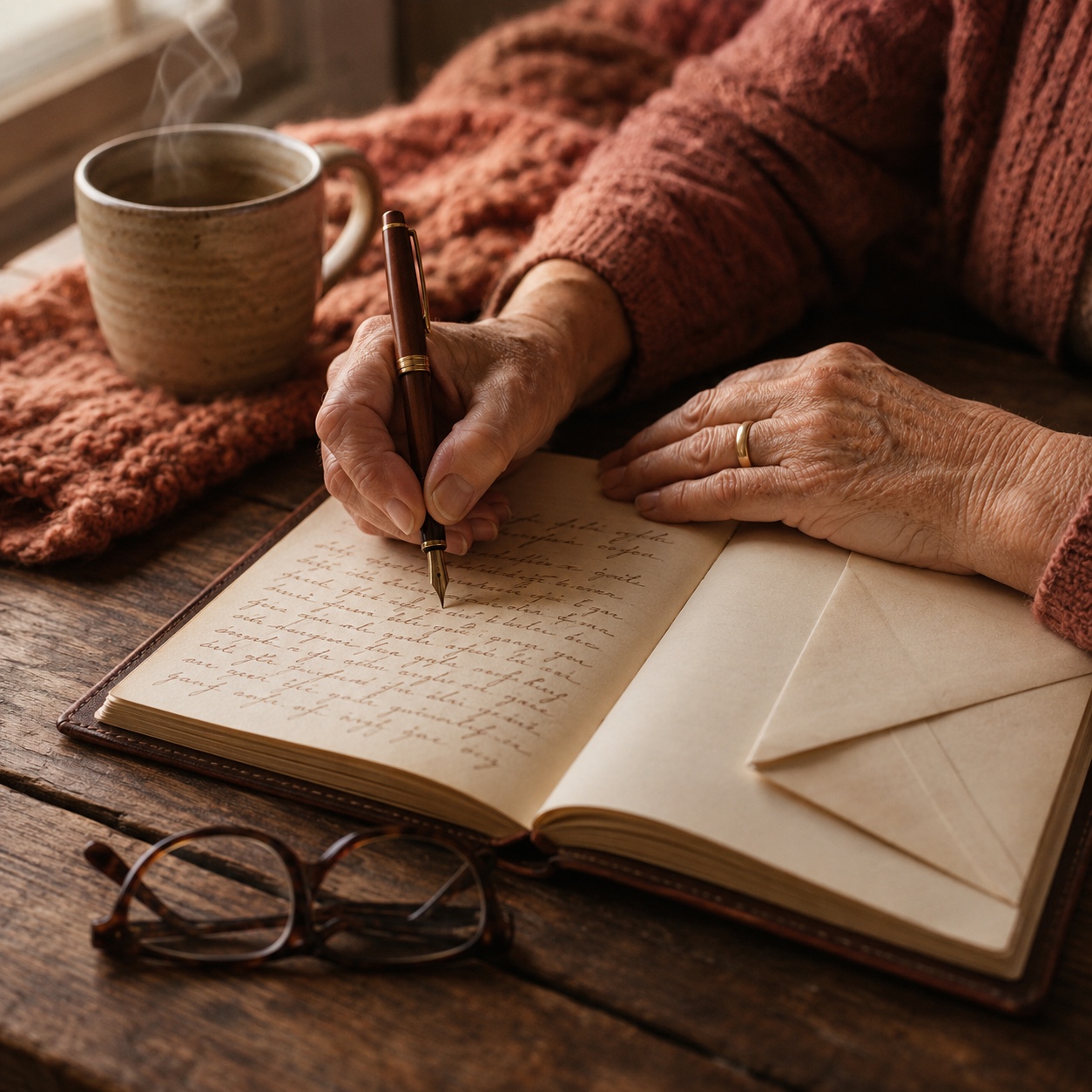
- A physical notebook posted back and forth, taking turns. Slow, but precious. Works well when only one distant relative reads; becomes impractical beyond two countries.
- A private family blog, accessible only to invited readers. Takes a little setting up, but offers a body of writing that can be reread.
- An online notebook designed for it, where each person puts down memories at their own pace and chooses who reads them. Some people use Carnely, which offers exactly that frame without a social network around it, without an algorithm, without a feed that scrolls past.
The criterion is being able to reopen, two years later, and find what your daughter wrote about her first winter in Toronto. If the chosen place doesn’t allow that easily, it isn’t the right one.
Bringing the youngest in
Grandchildren who grow up far from their grandparents often grow up in a language you don’t fully inhabit. It is a quiet loss, but a loss. Shared memories can help here too.
A drawing their mother scanned, a voice saying three words in your language, a photograph they chose themselves. They don’t need to write to be present in the thread. And when they do learn to write, the thread will already exist, and you won’t have to explain it to them.
Later, as teenagers, they reread. And they come across a memory of yours that no one else ever told them. That is the moment when distance, paradoxically, becomes an advantage: what you wrote survived the separation, because you took the trouble to write it down.
What distance does to memory
Families who live in the same town often talk about memories less than scattered families do. When you have dinner together every Sunday, you pass the salt, you talk about the week, you almost never tell the story of your mother’s rose bush or the neighbour from long ago. Closeness lets you skip writing down what you live.
Distance, on the other hand, forces the writing. And what it forces, it engraves. Many remarkable family archives have been written by grandparents whose children had moved away, not in spite of the separation, but because of it.
You aren’t writing to fill the distance. You are writing because the distance obliges you to choose what is worth saying. That is a chance.
Going further
If you want to start with one person and one form, this article describes how to put down a letter to your children without making it an event. And if the memories you want to share reach back to your childhood or your village of origin, here is how to tell where you come from.
By

Carnely's journal is kept by Pierre Goux, co-founder of Carnely. Articles on choosing and sharing what matters with the people close to you.