Share ·
Writing where you come from: your village, your house, your people
Writing where you come from doesn't require tracing a family tree. Start from what comes back when you close your eyes: a place, a few people, a handful of gestures, the sounds of a morning.
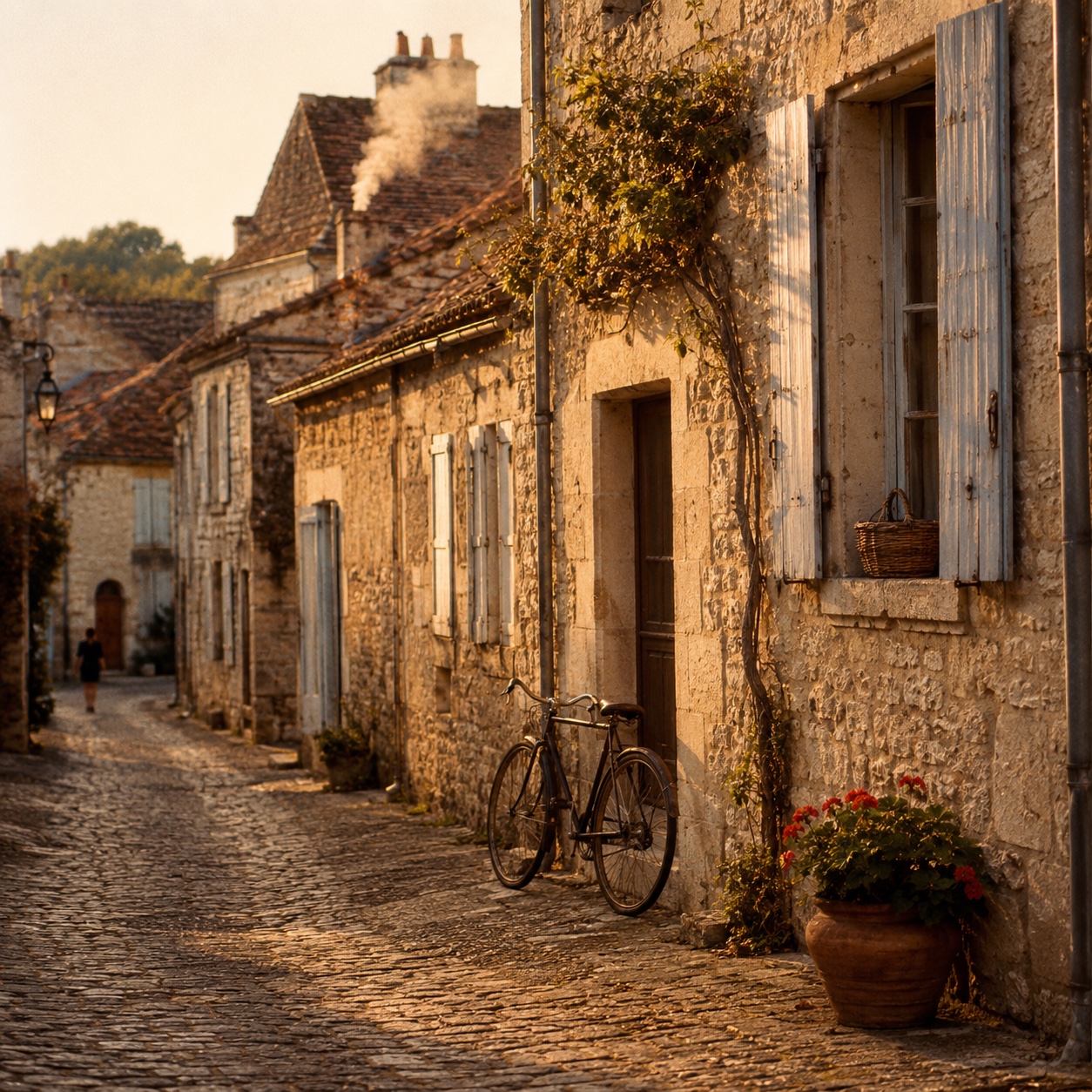
Close your eyes for a moment and ask yourself where you come from. Not the city on your ID, not the department printed on a form. The place that comes back without being called. A street, a kitchen, a corner of the garden, a window. A neighbour’s face, the smell of damp wood, the sound of a church bell.
Most people carry this matter without ever writing it down. They find it too ordinary, too local, not historical enough to deserve a page. And then one day, a grandchild who grew up in a city asks what was it like, at your place, and you realise you no longer quite know where to start.
This article offers a simple way to put down what you see when you close your eyes. Not a family tree, not a village monograph. Four concrete doors to fix what makes up your place of origin, at your own pace.
It’s not genealogy, and it’s not local history
We often confuse writing where you come from with two quite different exercises.
Genealogy traces names and dates, sometimes across centuries. It’s fascinating, patient, useful. But it doesn’t write your childhood.
Local history studies a village or a neighbourhood in a documentary way: archives, press, demography. It’s a work of scholarship that local associations do very well, and that doesn’t need you.
What only you can write is something else. It’s the lived memory of a place, seen first by a child and then by the adult that child became. It’s what no archive will ever contain: the colour of the light on the neighbour’s wall at six in the morning, your grandmother’s voice calling from one window to another, what people used to say about the postman who came on foot.
That’s the matter to set down. And it can be approached through four doors.
The place: putting down what you see first
Start with the setting. Not the whole village, not the whole house. The precise piece that comes back first when you close your eyes.
Describe it as if you were drawing it for someone who has never seen it. The street: wide or narrow, paved or unpaved, crossed in the morning by what. The house: how many rooms, which one you actually lived in, where you ate, where you slept. The yard, the garden, the shed, what opened onto what.
A few questions to get started, if nothing comes:
- Which room smelled of what?
- Which window looked out onto what?
- Where did you play when it rained?
- What could you see from the dining table?
- Which place was forbidden, and why?
You don’t have to cover everything. A page on the kitchen. Half a page on the yard. Little by little, the place takes shape.
The people: those who filled the place
A place doesn’t exist on its own. It exists through the people who passed through it.
There’s close family, of course, and you’ll write about them sooner or later. But what gets lost fastest are the secondary figures, the ones who made up the human backdrop without belonging to your household. The baker who slipped you a small bread. The neighbour across the road who spoke loudly. The schoolteacher. The doctor who came to the house. The postman. The priest. The local constable, if there still was one.
Put them down one by one. A paragraph per person, sometimes less. What they did, what they said, what people said about them. A scene where you really saw them.
A few prompts:
- Who walked the street, at what time?
- Whom did your mother or father greet with a particular word?
- Which adult frightened you a little?
- Which adult spoke to you as if you were grown up?
- Which shop closed, and what stood there afterwards?
These people have no biographical entry. If you don’t write them down, they fade.
The everyday gestures
Part of what we call where you come from is gestures. Not events, gestures. What you did every day without thinking, and don’t do any more.
The bread you walked to fetch, the newspaper read out loud, the radio on at midday. The Wednesday market, the Monday wash, the Sunday service or the refusal of it. Shopping that still went step by step, the butcher then the grocer then the greengrocer, with a conversation at each counter. The vegetable patch if there was one, and what came out of it.
These gestures speak of an era and a place at once. They also speak of a rhythm: what you did in the morning, the afternoon, the evening. What you did on weekdays, at the weekend, in summer.
A few starting questions:
- How did a Sunday go, morning to evening?
- What was done, in the evening, before television?
- Which gesture did your father or mother teach you, and you still make today?
- Which gesture did you stop making when you left home?
These fragments are worth their weight in gold. Those close to you don’t know them. They think they do, because they’ve seen a period film, but they don’t.
The sounds, the smells, the light
The last door is the slenderest and often the most accurate: sensory memory. What you used to hear, what you used to smell, how the light fell.
The cry of swallows in summer, the siren at noon, the school bell, the neighbour’s tractor engine, the radio crackling. The smell of your mother’s cooking, the smell of a barn, the smell of dry laundry, the smell of rain on warm earth. The five o’clock light on the wall across the street, the winter light on the breakfast table.
These memories carry an odd precision: you don’t remember a year, but you remember a sound exactly. Use them. They’re the fastest entry doors when you’re stuck. If you want to dig further down this path, there’s a whole article on sensory memories and how to put them on the page.
Keeping this matter somewhere
You won’t write all of it in one evening, and that isn’t the project. The project is to have a place where it can settle, without pressure, at your own pace.
Some people keep a paper notebook. Others write in a digital document over the weeks. Others use a digital book like Carnely, which asks the questions one at a time in a chapter devoted to your origins: where you grew up, who passed in the street, what was done on Sundays. You answer when you want, you come back later, you add a photograph if one is still around. The matter thickens on its own.
After a quarter of a year, you have a place set down. A place where your daughter, your son, your grandchild can walk in one day and know where you come from, really. Not a civil-status form. A place, some people, a few gestures, a handful of sounds.
That’s what writing where you come from is. Not a study. A gift you put down, page by page, for your loved ones.
By

Carnely's journal is kept by Pierre Goux, co-founder of Carnely. Articles on choosing and sharing what matters with the people close to you.